
Remember when electric cars were supposed to be small?
Lightweight.
Aerodynamic.
Efficient little things designed to quietly transport a couple of people around the city while using as little energy as possible.
Yeah.
About that.
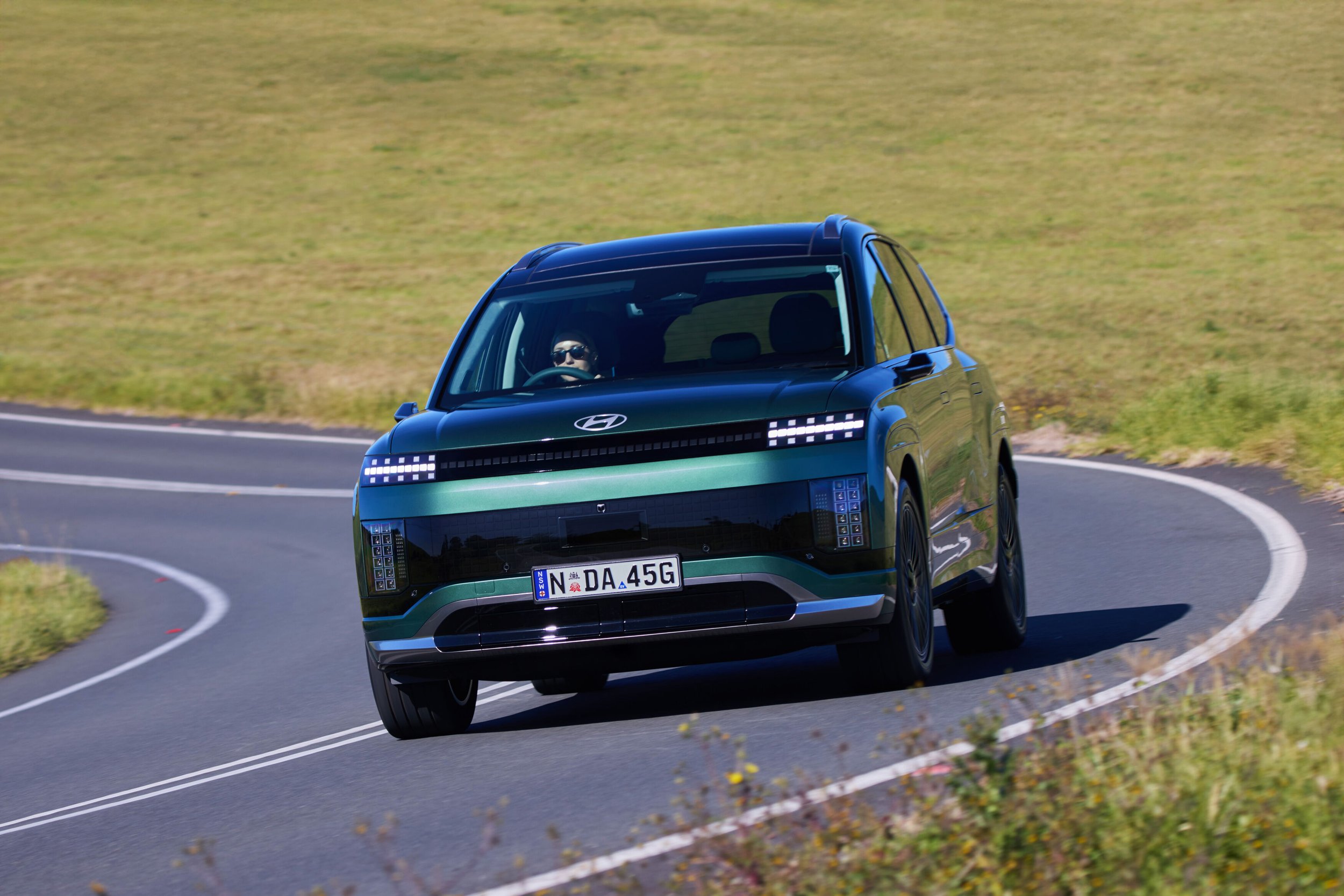
Meet the Hyundai IONIQ 9.
It's more than five metres long, can carry up to seven people, has a wheelbase longer than some entire small cars and, depending on specification, sends more than 300kW through all four wheels.
Apparently nobody told Hyundai that EVs were supposed to be little eco-boxes.
And I'm rather glad they didn't.
Because underneath the enormous dimensions and considerable amount of technology is something surprisingly straightforward:
A genuinely useful electric family SUV.
Not an EV that happens to have seven seats.
Not a technological experiment with some cupholders added afterwards.
A proper family SUV that just happens to run entirely on electricity.
And perhaps that's the most important distinction of all.
Price and Key Specifications:
The IONIQ 9 arrives in Australia as Hyundai's flagship electric SUV, sitting above the IONIQ 5 and IONIQ 6 and sharing its fundamental E-GMP electric architecture with vehicles including the Kia EV9.
Three variants form the Australian range: Dynamiq, Calligraphy and Calligraphy Performance.
And this isn't cheap motoring.
The range begins at around $120,000 before on-road costs, while the flagship Performance pushes beyond $140,000.
For a Hyundai.
Yes, we're having this conversation again.
But as we discovered with the new Palisade, judging modern Hyundai products against what the badge represented twenty years ago is becoming increasingly pointless.
All IONIQ 9 variants use an enormous 110.3kWh battery, while outputs vary depending on specification.
The rear-wheel-drive Dynamiq prioritises range, while Calligraphy adds a second electric motor and all-wheel drive. The flagship Performance turns things up considerably further, producing 315kW and 700Nm.
That means the biggest Hyundai currently on sale can also accelerate from 0-100km/h in a claimed 5.2 seconds in Performance guise.
Because apparently your seven-seat family bus needs to embarrass hot hatches at traffic lights.
Obviously.
More importantly, claimed WLTP driving range stretches beyond 600km in the most efficient configuration.
And that number matters far more.
Design:
The IONIQ 9 is enormous.
There's no clever way of putting that.
At more than five metres long and almost two metres wide, it occupies a serious amount of road.
But Hyundai's designers have done an impressive job of preventing it from looking like an apartment building with wheels.
The shape is unusually smooth.
Hyundai describes it as an Aerosthetic design, which sounds suspiciously like a word invented during a marketing meeting, but the thinking behind it makes sense.
The roofline flows gently towards the rear.
The bodywork is remarkably clean.
And Hyundai's now-familiar Parametric Pixel lighting gives the IONIQ 9 an unmistakable family resemblance to the IONIQ 5 and IONIQ 6.
It looks futuristic without looking ridiculous.
Mostly.
The rear is perhaps the most divisive angle.
There's something almost boat-like about it, particularly around the enormous tailgate and vertical pixel lighting.
But it's certainly distinctive.
And I increasingly appreciate manufacturers willing to make EVs look like something other than regular SUVs with a blank panel where the grille used to be.
Hyundai has created a genuine IONIQ design language.
You might not love every part of it.
But you'll know exactly what you're looking at.
Interior and Practicality:
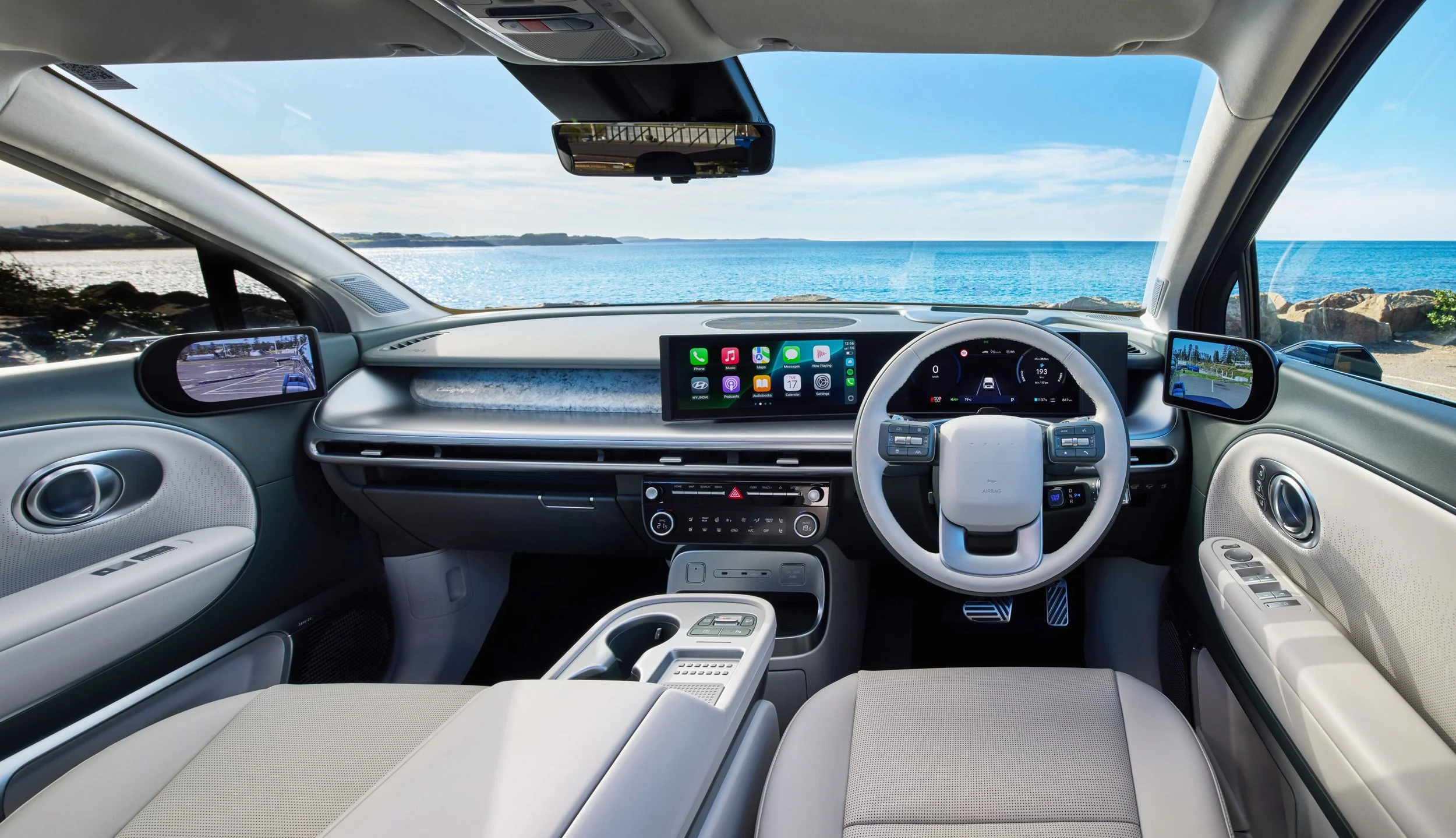
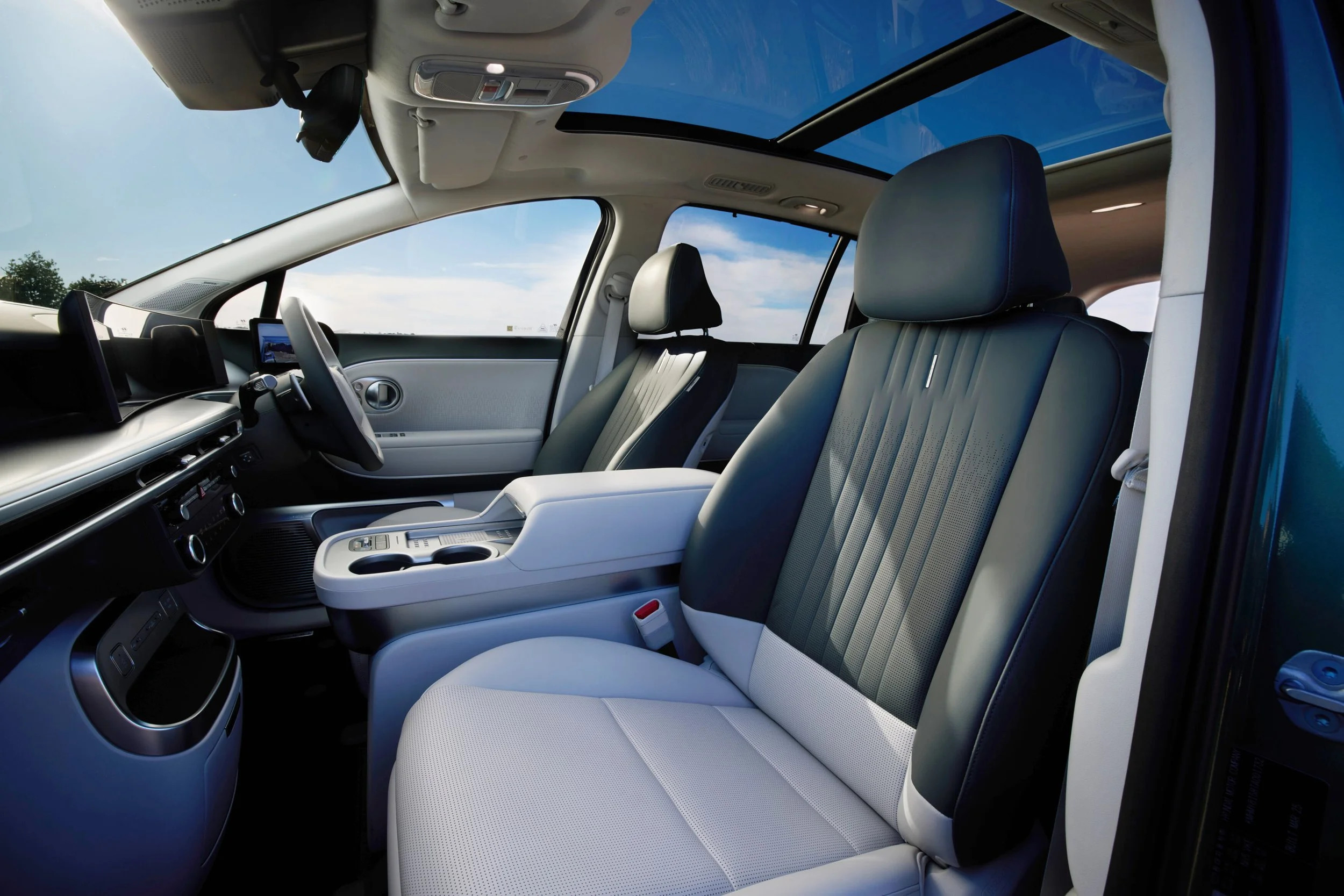
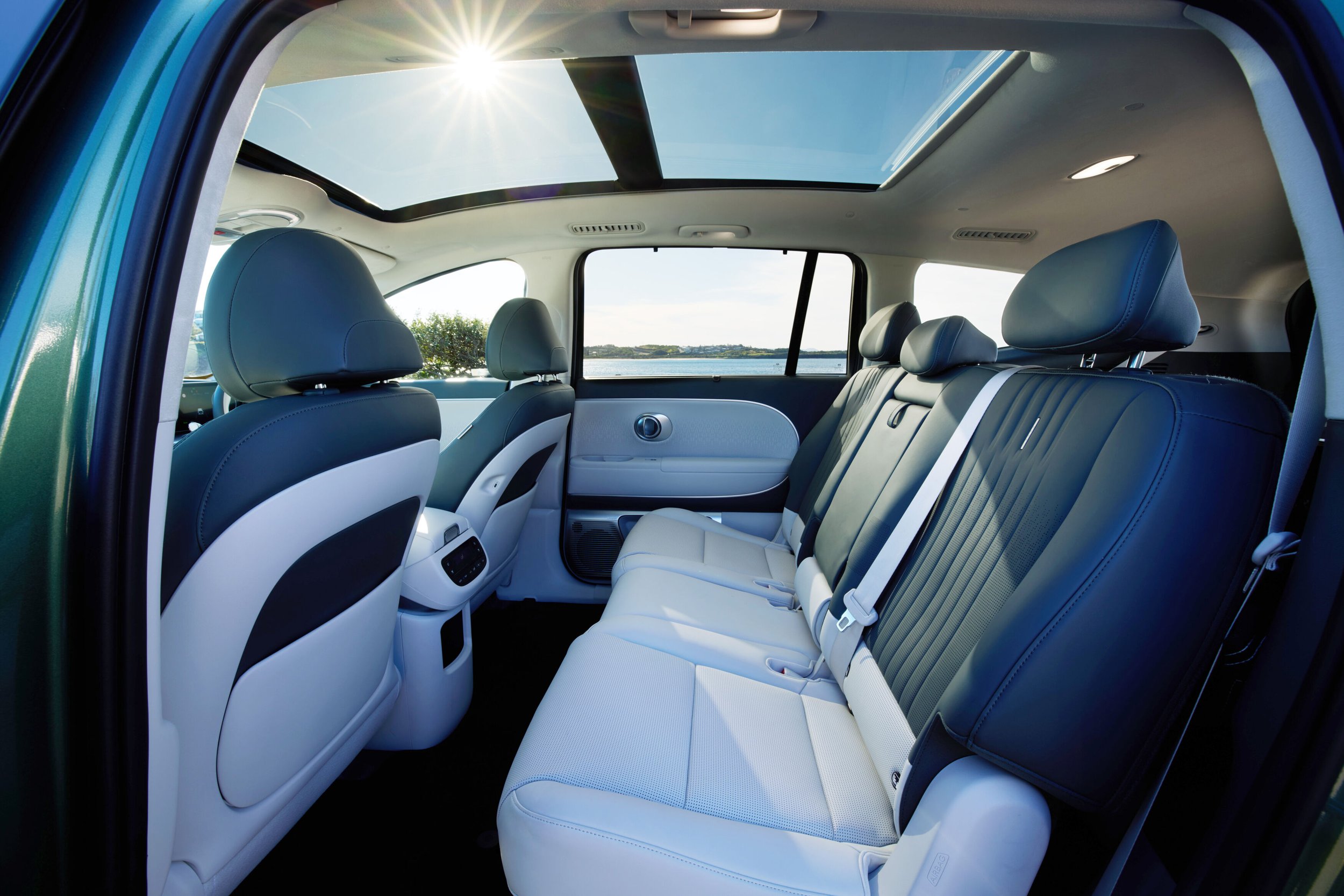
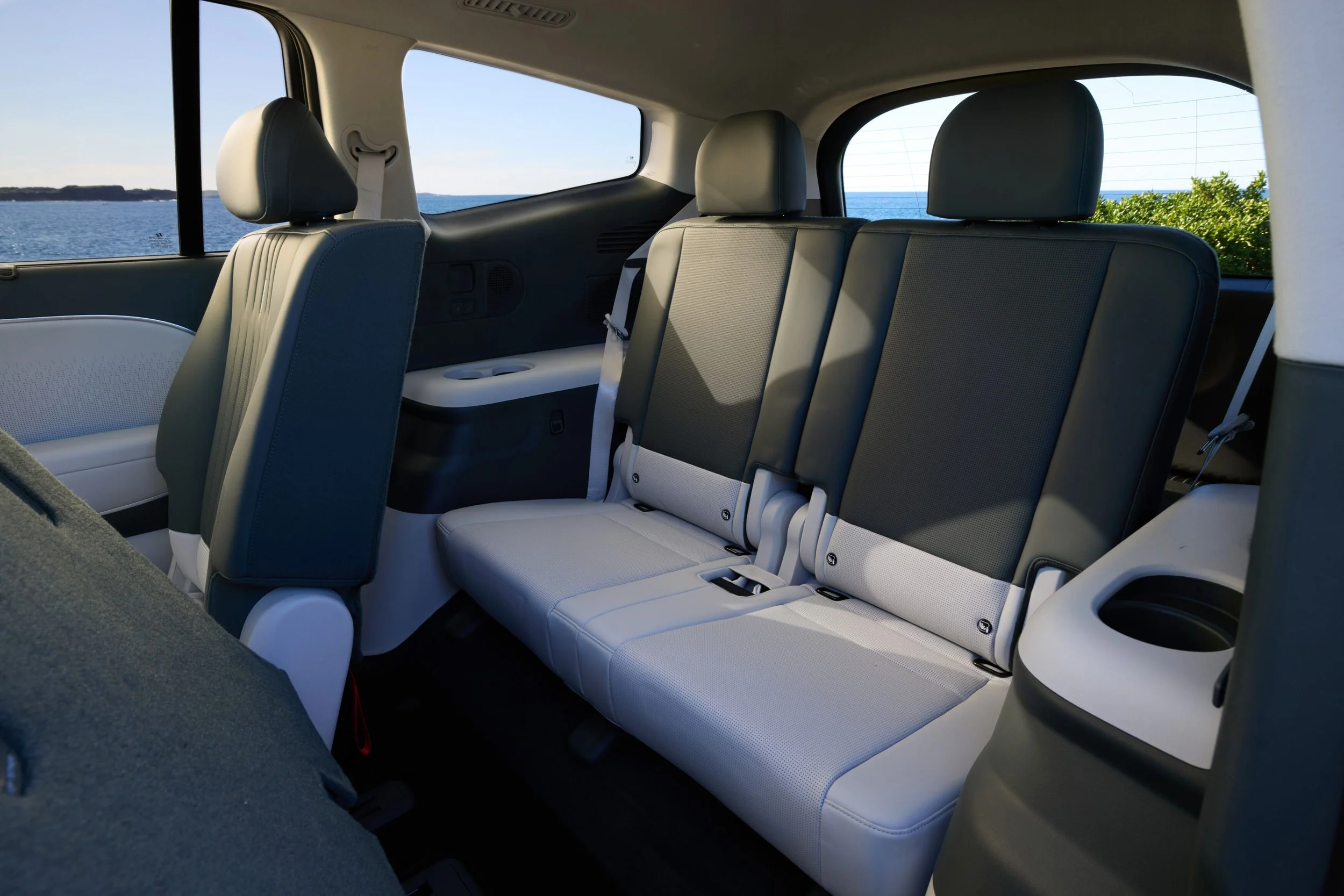
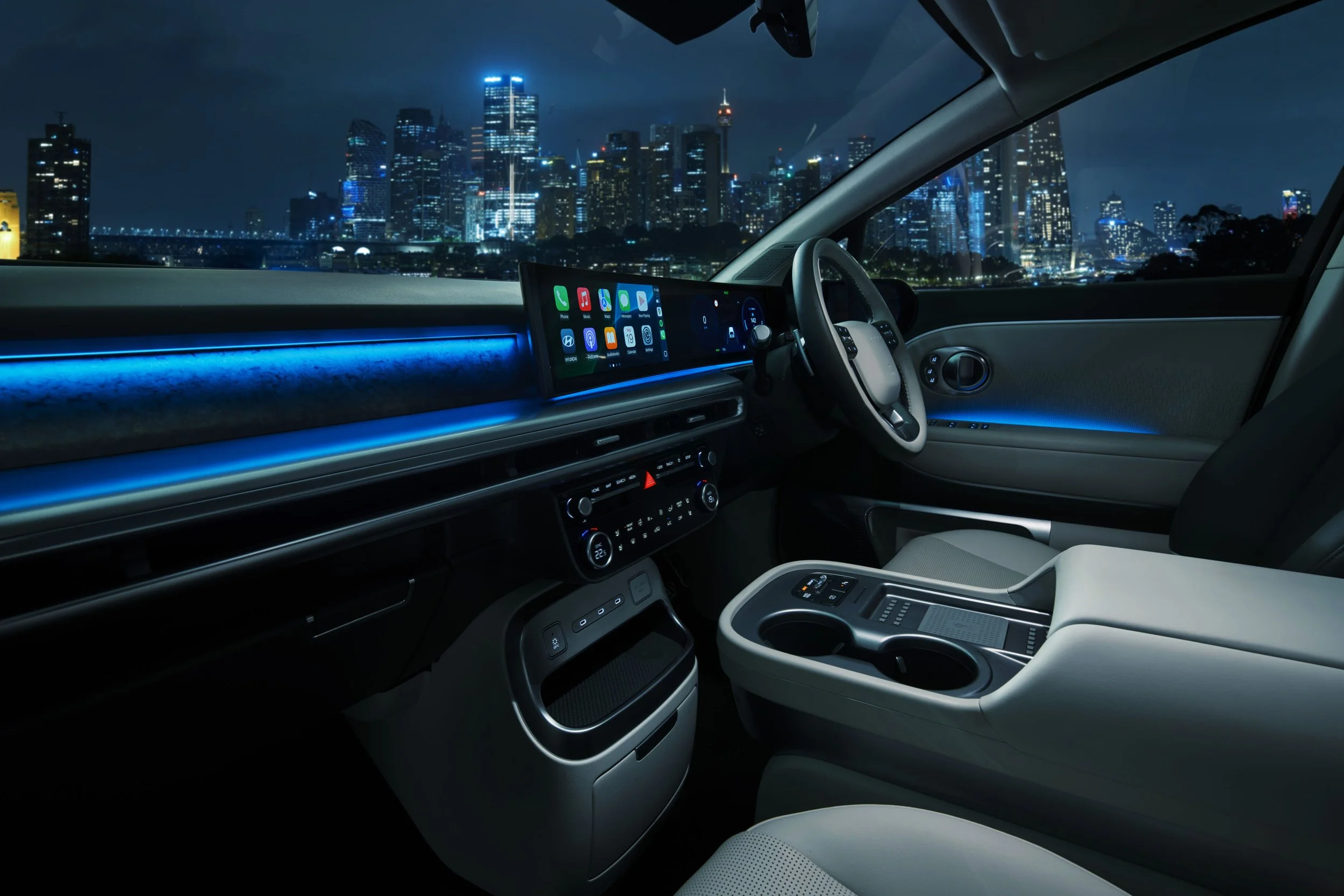
This is where the IONIQ 9 starts making an enormous amount of sense.
Because the real luxury here isn't leather.
It isn't ambient lighting.
It isn't the screens.
It's space.
There is an absurd amount of it.
The completely flat floor and enormous wheelbase allow Hyundai to use virtually every millimetre of the cabin, and the result feels less like climbing into an SUV and more like entering a small lounge room.
A very technologically advanced lounge room.
The dashboard itself is relatively restrained.
Twin 12.3-inch displays handle instrumentation and infotainment duties, while Hyundai — thankfully — retains physical controls for several commonly used functions.
There are buttons.
Actual buttons.
Once again:
Thank you, Hyundai.
Apparently somebody in Seoul still understands that adjusting the temperature shouldn't require navigating a submenu while travelling at 100km/h.
Material quality is excellent, particularly in Calligraphy specification.
Soft-touch surfaces cover the important areas, the seats are beautifully finished and the whole cabin has a calm, almost minimalist atmosphere.
But the cleverness is in the details.
The centre console can slide.
There are storage areas everywhere.
USB-C ports seem to multiply every time you look around the cabin.
And because there's no transmission tunnel running through the vehicle, moving between the front seats and rear cabin becomes considerably easier.
It's the sort of interior that feels like somebody actually put a family inside the prototype before signing off the design.
An increasingly novel concept.
The Second Row:
Here we go again.
Apparently Hyundai has declared war on uncomfortable children.
Higher-specification six-seat versions replace the conventional second-row bench with individual captain's chairs, creating something remarkably close to business-class seating.
Depending on configuration, occupants can recline, stretch out and generally enjoy a level of comfort that would have seemed absurd in a Hyundai not particularly long ago.
Which brings us back to an important question from the Palisade review:
Do children deserve this?
Still no.
Nothing has changed.
I spent childhood road trips sitting in the back of cars with seats approximately as comfortable as outdoor furniture.
Today's children get climate control, USB-C charging and reclining captain's chairs.
They don't know they're alive.
Joking aside, the second row is superb.
And unlike many three-row SUVs, accessing the third row doesn't require advanced gymnastics.
The Third Row:
This is perhaps more important.
Because plenty of SUVs advertise seven seats.
Far fewer offer seven seats you'd voluntarily put people in.
The IONIQ 9's third row benefits enormously from the vehicle's electric architecture.
There's usable legroom.
There's decent headroom.
And because the floor doesn't rise dramatically beneath passengers' feet, adults aren't forced into the knees-under-chin seating position common in smaller seven-seaters.
Children will obviously be perfectly comfortable.
Adults?
They can actually stay there.
For more than twenty minutes.
That's an achievement.
There's also useful luggage space remaining with all three rows occupied, and folding the third row creates the sort of enormous load area you'd expect from something this size.
There's even additional storage under the bonnet.
Or a frunk.
Front trunk.
Whatever we're collectively calling it this week.
Driving:
Here's where the IONIQ 9 does something rather clever.
It doesn't try to feel sporty.
Thank goodness.
We've reached a strange point in automotive history where manufacturers seem convinced every enormous SUV needs steering developed at the Nürburgring.
It doesn't.
Nobody has ever loaded three children, two suitcases, a pram and a week's worth of groceries into a seven-seat SUV and thought:
"I really hope the turn-in is aggressive."
Hyundai understands the assignment.
The IONIQ 9 is tuned primarily around comfort.
And it shows.
The ride is impressively compliant, particularly considering the enormous wheels fitted to higher specifications.
Road noise is extremely well suppressed.
Wind noise is minimal.
And without an internal-combustion engine doing anything up front, the cabin remains wonderfully quiet.
It suits the car perfectly.
Acceleration is similarly effortless.
Even the less powerful versions have the immediate torque response inherent to electric motors.
Put your foot down and something this enormous simply gathers speed without drama.
The Performance?
That's different.
With 315kW and 700Nm, it can move with frankly unnecessary enthusiasm.
And yes.
Unnecessary things can still be entertaining.
There's something inherently amusing about burying the accelerator in what amounts to an electric family lounge room and watching the horizon suddenly arrive much sooner than expected.
But after doing that once or twice, you'll probably return to driving it the way it wants to be driven.
Quietly.
Smoothly.
Comfortably.
And that's where the IONIQ 9 is at its best.
Range and Charging:
Now we get to the question that matters with any large electric family SUV.
Can you actually travel in it?
Increasingly, yes.
The enormous 110.3kWh battery gives the IONIQ 9 a claimed range exceeding 600km in its most efficient configuration.
Real-world highway driving will naturally reduce that figure, particularly with a full cabin, luggage, air-conditioning and larger wheels.
But we're well beyond the era of large EVs offering 300km and asking their owners to simply be brave.
Then there's Hyundai's 800-volt electrical architecture.
This remains one of the E-GMP platform's greatest strengths.
Connect the IONIQ 9 to a sufficiently powerful DC fast charger and Hyundai claims a 10-80 per cent recharge in around 24 minutes.
Read that again.
A battery with more than 110kWh of capacity.
10 to 80 per cent.
Around 24 minutes.
That's impressive.
It's also exactly the kind of technology that matters far more to EV ownership than another half-second removed from the 0-100km/h time.
Fast charging changes road trips.
And Hyundai remains amongst the best in the business at it.
Vehicle-to-Load:
There's another E-GMP party trick worth mentioning.
Vehicle-to-load.
The IONIQ 9 can essentially become a giant mobile power bank.
Using the appropriate outlet or adaptor, energy stored within the vehicle's battery can power external electrical equipment.
Camping?
Run appliances.
Working remotely?
Charge equipment.
Blackout at home?
There are suddenly more than 100kWh of electricity sitting in your driveway.
Obviously, you're not going to power everything indefinitely.
But the capability is genuinely useful.
And unlike some automotive technology, it solves an actual problem.
We approve.
Technology:
There's plenty.
Wireless Apple CarPlay and Android Auto are available, along with wireless phone charging, digital instrumentation, connected navigation and Hyundai's extensive suite of cameras.
And yes, Blind-Spot View Monitor makes another appearance.
Indicate and a camera feed of the corresponding blind spot appears directly within the instrument display.
We've praised it before.
We're going to praise it again.
Why doesn't everyone do this?
Seriously.
It's brilliant.
Higher specifications also bring the expected collection of premium audio, surround-view monitoring, head-up display and comfort technology.
But what I appreciate most is that Hyundai generally avoids making the technology feel like the entire reason the vehicle exists.
The screens support the car.
They aren't the car.
There's a difference.
Safety:
Unsurprisingly, the IONIQ 9 comes loaded with Hyundai's latest SmartSense driver-assistance systems.
There's autonomous emergency braking, adaptive cruise control, blind-spot monitoring, rear cross-traffic assistance, lane-keeping assistance and lane-following technology, amongst numerous other systems.
The extensive camera coverage is particularly valuable in something nearly two metres wide.
Because regardless of how many clever sensors Hyundai installs, physics still says this thing is enormous.
Thankfully, the IONIQ 9 does a decent job of making you forget that from behind the wheel.
Until you find a small underground car park.
Then you'll remember.
Quickly.
Ownership:
Hyundai's Australian warranty coverage provides the usual reassurance, while the high-voltage battery receives separate long-term protection.
But one of the advantages of the IONIQ 9's electric drivetrain is reduced routine mechanical servicing.
No engine oil.
No spark plugs.
No exhaust.
No conventional automatic transmission.
Fewer moving parts generally means fewer traditional maintenance items.
Tyres, however?
Those still exist.
And they're being asked to control more than two-and-a-half tonnes of SUV with instant electric torque.
So don't expect them to cost $180 each.
The Competition:
The obvious rival is the Kia EV9.
They're related underneath, share Hyundai Motor Group's E-GMP architecture and attack essentially the same problem.
But they approach it differently.
The EV9 is angular.
Bold.
Almost architectural.
The IONIQ 9 is softer.
Smoother.
More lounge-like.
Then there are premium electric SUVs from BMW, Mercedes-Benz and Volvo, along with a rapidly growing collection of Chinese competitors.
And that's where Hyundai's pricing becomes interesting.
Because once you're spending $120,000, $130,000 or $140,000 on a vehicle, the badge inevitably becomes part of the conversation.
Some buyers simply won't spend that money on a Hyundai.
Fair enough.
But we're increasingly reaching the same conclusion with several of the company's flagship products.
Sit inside one before you decide.
Because the gap between what people think a Hyundai should feel like and what Hyundai is actually building has become enormous.
Verdict:
The IONIQ 9 isn't really about electricity.
That sounds strange considering it doesn't have an engine.
But hear me out.
The best thing about this car isn't the battery.
It isn't the 800-volt architecture.
It isn't the 315kW available in the Performance.
It's the fact that Hyundai has used an electric platform to build a better family SUV.
The floor is flat.
The cabin is enormous.
The second row is superb.
The third row is genuinely usable.
It's quiet.
It's comfortable.
It can travel serious distances.
And when you do need to charge, it can replenish its enormous battery remarkably quickly.
That's what electric architecture should be doing.
Not simply producing absurd acceleration figures.
Making the car itself better.
Is it expensive?
Absolutely.
Is it enormous?
Very.
Will you occasionally reconsider your life choices while attempting to park it at Westfield?
Almost certainly.
But if you need three proper rows of seats and you're ready to make the switch to electric, the IONIQ 9 makes a surprisingly convincing argument.
Hyundai hasn't built an electric SUV that happens to work for families.
It has built a family SUV that happens to be electric.
And that's a far more important achievement.