
Nearly $100,000.
For a Hyundai.
There was a time when putting those two things in the same sentence would have sounded completely absurd.
And yet, here we are.
The 2026 Hyundai Palisade Calligraphy Hybrid AWD can nudge remarkably close to six figures once it's sitting in your driveway.
The obvious question, then, is:
Has Hyundai lost its mind?
Spend some time inside the new Palisade and the answer becomes considerably more complicated.
Because Hyundai hasn't simply taken the previous Palisade, added another screen, stitched some nicer leather across the seats and increased the price.
This is an entirely new vehicle.
It's bigger.
More sophisticated.
More luxurious.
And for Australia, its headline powertrain is now a turbocharged petrol-electric hybrid producing 245kW and 460Nm.
Most importantly, the Palisade no longer feels like a mainstream SUV attempting to impersonate something premium.
It feels properly premium.
Which creates a fascinating problem.
Because once Hyundai builds a car this good, at what point are we supposed to stop saying:
"Yeah, but it's a Hyundai?"
Price and Key Specifications:
The flagship 2026 Hyundai Palisade Calligraphy Hybrid AWD starts from $89,900 before on-road costs in eight-seat form, while choosing the seven-seat configuration lifts that to $90,900.
That's serious money.
We'll come back to that.
Under the bonnet is a 2.5-litre turbocharged four-cylinder petrol engine, paired with an electric motor and small 1.65kWh battery.
The petrol engine produces 192kW and 353Nm, while the electric motor contributes 54kW and 264Nm.
Combined system output is a substantial 245kW and 460Nm, delivered to all four wheels through a conventional six-speed automatic transmission.
And I like that last part.
No CVT.
No strange single-speed hybrid arrangement.
No transmission that sends the engine screaming towards the redline every time you attempt to merge onto a motorway.
A proper automatic gearbox.
Thank you, Hyundai.
Official combined fuel consumption is 6.8L/100km, impressive considering the Palisade is more than five metres long and weighs comfortably over two tonnes.
There's also a 2,000kg braked towing capacity.
So while the new Palisade has certainly become more luxurious, it hasn't forgotten the family-SUV part of the brief.
Design:
The previous Palisade was handsome.
The new one has presence.
There's an important difference.
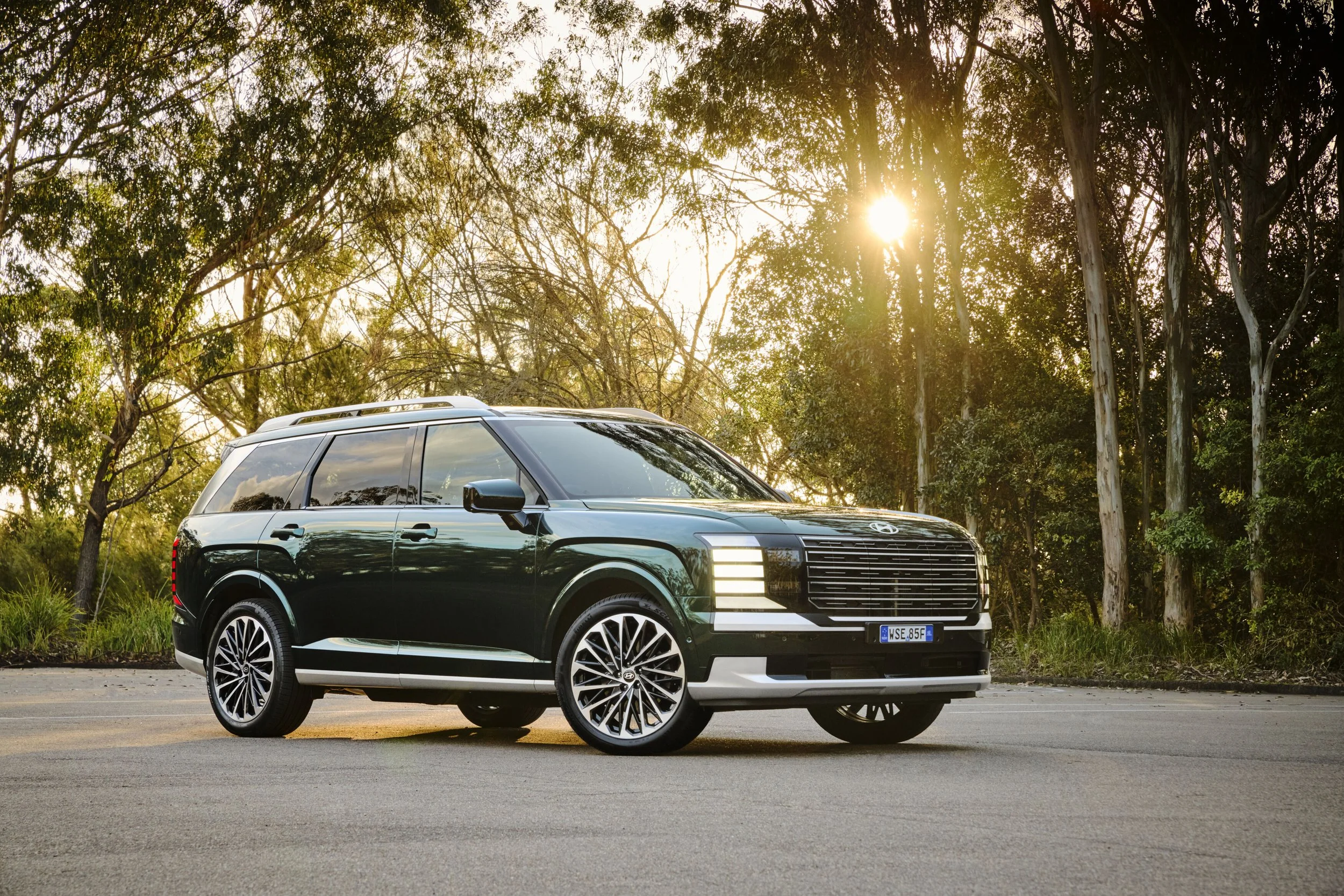
At 5,060mm long and 1,980mm wide, this is a substantial vehicle, and Hyundai hasn't attempted to disguise that fact.
Instead, the design embraces it.
The new Palisade is boxier and considerably more upright than before, with an enormous front-end treatment dominated by vertical lighting elements and a broad grille.
There's almost a hint of Range Rover about the proportions.
Not because Hyundai has copied one.
But because the designers have clearly understood something luxury SUV manufacturers have known for years:
Big SUVs look good when they look big.
The Calligraphy's 21-inch alloy wheels fill the arches nicely, while the sheer sides and strong shoulder line give the Palisade a much more substantial appearance than its predecessor.
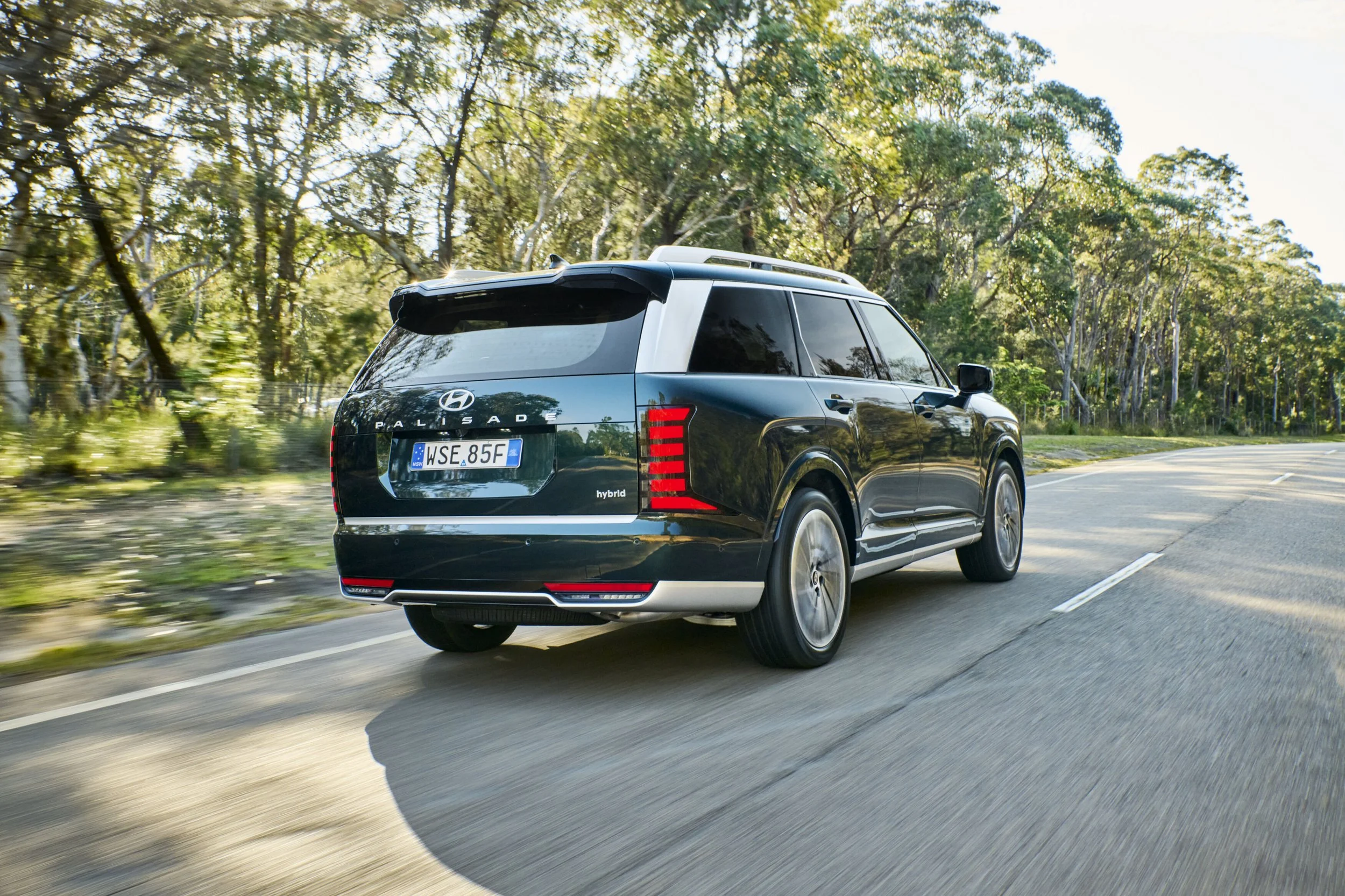
From the rear, the upright design continues.
It's clean.
Simple.
Confident.
And importantly, Hyundai hasn't covered the thing in fake vents and unnecessary pieces of gloss-black plastic in an attempt to make a three-row family SUV look like it's about to enter a touring-car championship.
Good.
It's a Palisade.
Not an i30 N.
Let it be a Palisade.
Interior and Practicality:
This is where things get interesting.
Because if you're still struggling with the idea of spending around $90,000 before on-roads on a Hyundai, climb inside one.
Then we'll talk.
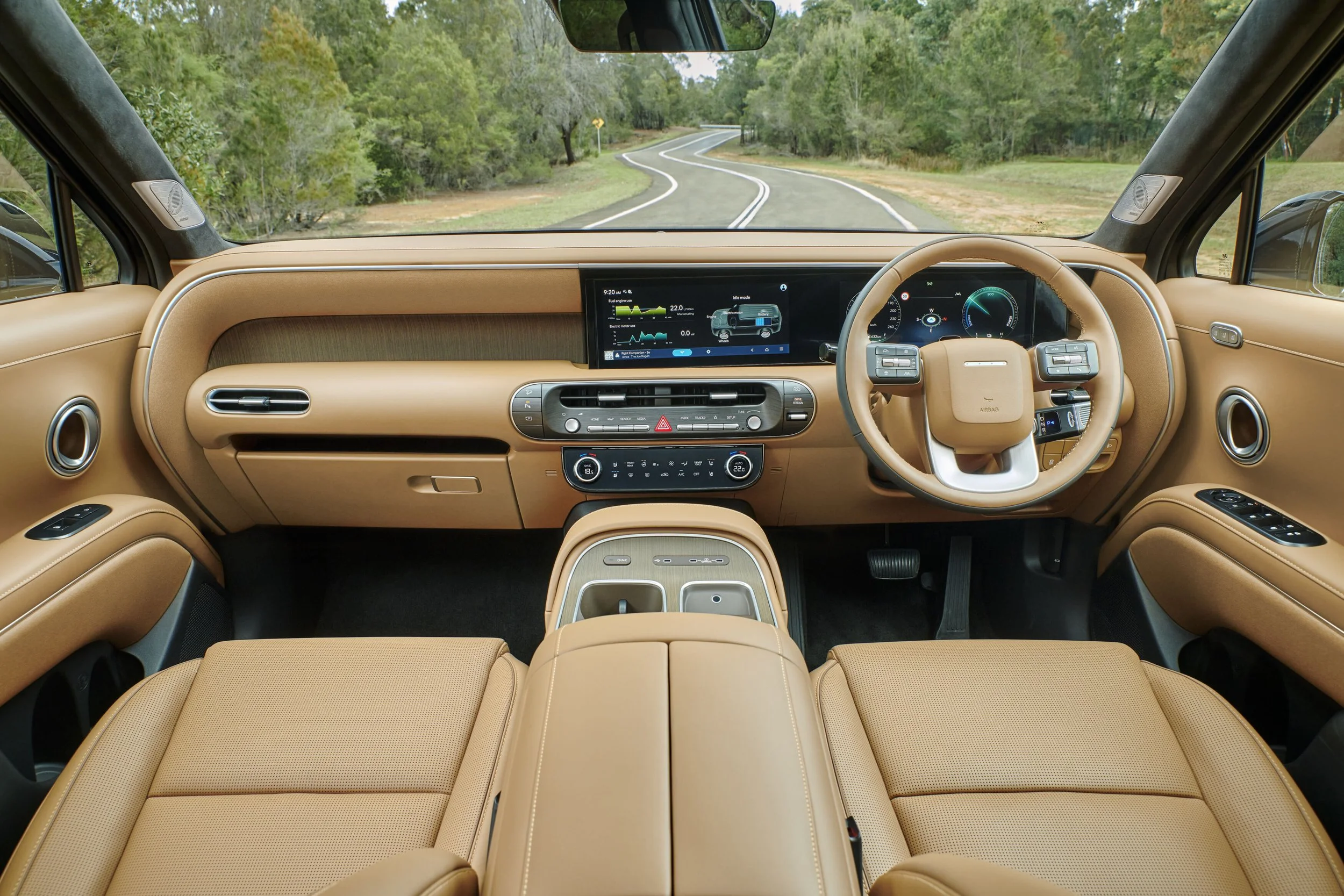
The new Palisade Calligraphy interior is excellent.
Not excellent for a Hyundai.
Excellent.
Full stop.
There are twin 12.3-inch displays across the dashboard, but Hyundai hasn't simply glued enormous televisions to every available surface and declared the interior futuristic.
There are still physical controls.
Actual buttons.
For things you use regularly.
What a concept.
Thank you, Hyundai.
Material quality is similarly impressive.
The Calligraphy receives Nappa-appointed leather, a suede-appointed headlining, ambient lighting and beautifully finished trim throughout the cabin.
The front seats are heated and ventilated and incorporate Hyundai's Premium Relaxation function with extending leg rests.
Yes.
A Hyundai Palisade now has reclining relaxation seats with leg rests.
Remember when Hyundais came with a cassette player?
We've come some distance.
There's also a head-up display, digital centre mirror, heated steering wheel and a 14-speaker Bose audio system.
But the real luxury isn't any individual feature.
It's space.
There's loads of it.
The Palisade can be configured with seven or eight seats, and unlike plenty of SUVs that technically have a third row, the seats back there are actually usable.
Adults can fit.
Children certainly can.
And nobody needs to remove their legs before climbing aboard.
There's 300 litres of luggage capacity behind the third row, expanding to 712 litres with it folded and a cavernous 2,081 litres with the second row down as well.
This is what a proper family SUV should be.
Not simply enormous outside.
Actually useful inside.
The Second Row:
Normally, the second row gets a few sentences buried somewhere in the practicality section.
Not here.
Because if you're buying the seven-seat Calligraphy, the middle row is arguably one of the best seats in the house.
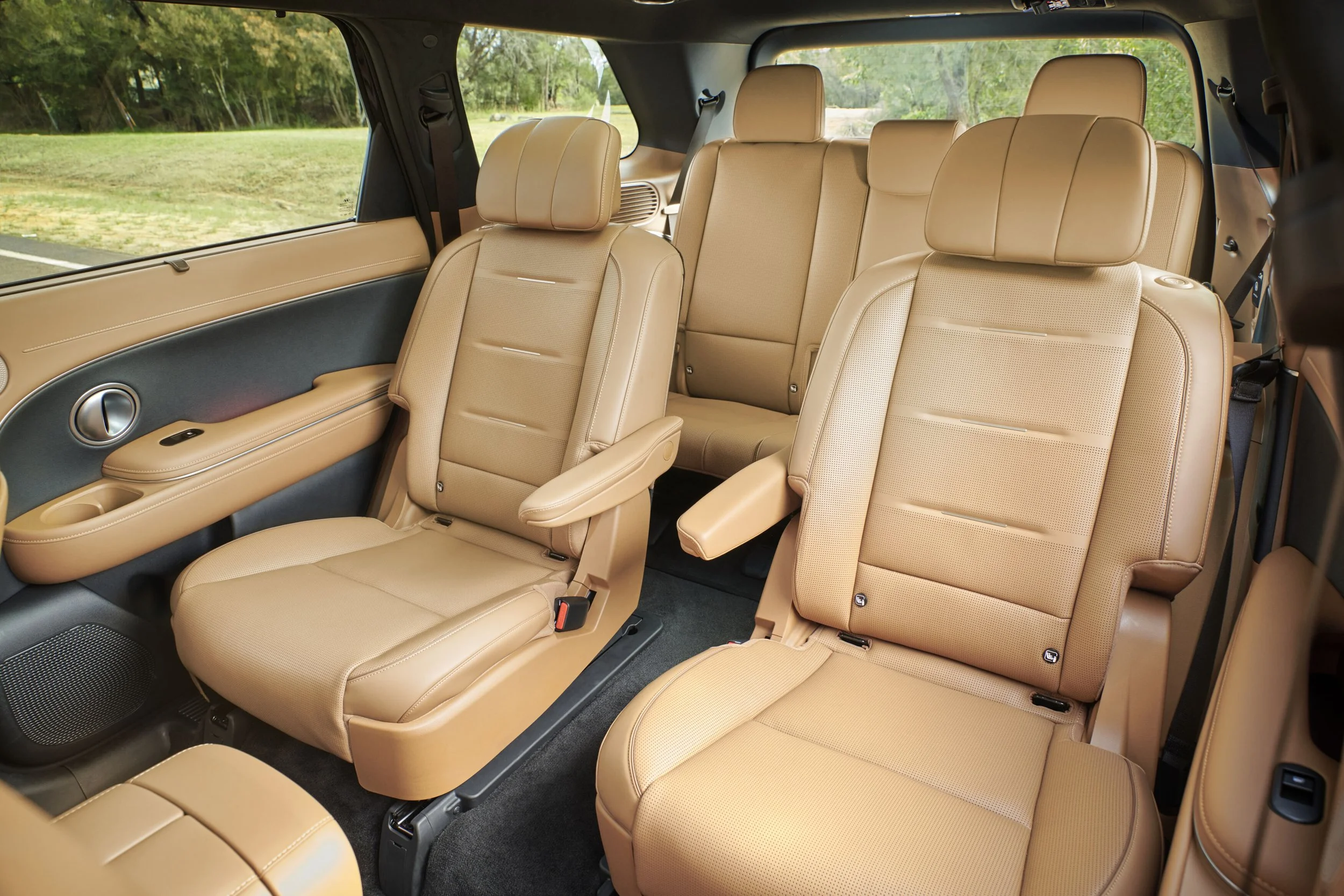
The seven-seater receives individual second-row relaxation seats.
They're heated.
They're ventilated.
They recline.
They have their own armrests.
And suddenly the children are travelling considerably better than you did in Business Class on your last domestic flight.
This raises an important parenting question.
Do children deserve ventilated captain's chairs?
No.
Obviously not.
They can sit on a milk crate like we did.
Unfortunately, Hyundai disagrees.
And once your children discover those buttons, there's absolutely no going back.
There are USB-C outlets scattered throughout the cabin, plenty of storage, cupholders everywhere and enough charging capability to keep an entire family's collection of electronics alive on a road trip.
Hyundai understands how families actually use cars.
And it shows.
Driving:
The previous Palisade was available with Hyundai's excellent 2.2-litre turbo-diesel.
It's gone.
I know.
Give diesel enthusiasts a moment.
The replacement hybrid, however, makes a surprisingly convincing argument for itself.
Around town, the electric motor can handle small movements and assist the petrol engine during acceleration, making the Palisade remarkably quiet and smooth in everyday driving.
There's none of the slightly agricultural soundtrack that occasionally accompanied the old diesel.
Instead, you pull away quietly.
The petrol engine joins proceedings when required.
And most of the time, the transition between the two is impressively unobtrusive.
With 245kW and 460Nm, there's also considerably more performance available than you might expect from something this large.
Nobody needs a Palisade to be fast.
But nobody enjoys a two-tonne SUV feeling underpowered either.
The hybrid sits nicely between those extremes.
Put your foot down and there's enough shove to merge, overtake and move the family around without drama.
Then back off and it returns to being quiet and relaxed.
Exactly as it should.
The steering is light around town, visibility is excellent and the various camera systems make manoeuvring nearly five metres of Hyundai considerably less intimidating than the dimensions suggest.
The suspension also deserves praise.
There's an underlying softness to the Palisade that suits its purpose beautifully.
This isn't pretending to be a sports SUV.
And thank goodness for that.
There are no rock-hard dampers attempting to convince you that taking the children to swimming lessons is somehow qualifying for the Nürburgring.
It rides like a luxury family SUV.
Because that's what it is.
Hybrid Life:
Importantly, this isn't a plug-in hybrid.
There's nothing to charge.
No cable to remember.
No wallbox required.
The Palisade manages its small battery itself, recovering energy through regenerative braking and using the electric motor whenever it makes sense.
For the average family, that's incredibly easy.
You simply drive it.
Hyundai claims 6.8L/100km on the combined cycle.
As always, real-world consumption will depend heavily on where and how you drive.
But there's something inherently satisfying about a huge, seven- or eight-seat SUV consuming fuel at a rate that would once have been respectable for a medium-sized sedan.
That's progress.
Not as exciting as 0-100km/h in three seconds.
But considerably more useful when you're paying the fuel bill.
Technology:
The Palisade contains an enormous amount of technology.
But perhaps more importantly, most of it feels like technology designed to make life easier rather than simply giving the brochure another bullet point.
Wireless Apple CarPlay and Android Auto?
Of course.
Wireless charging?
Naturally.
Head-up display?
Yep.
Digital rear-view mirror?
Absolutely.
Surround-view cameras?
Essential in something roughly the dimensions of a regional shopping centre.
There's also Hyundai's excellent Blind-Spot View Monitor, which displays a live camera image within the instrument cluster when you indicate.
We've said this before and we'll say it again:
Why doesn't everyone do this?
It's brilliant.
Simple.
Useful.
Exactly what automotive technology should be.
Safety:
As you'd expect, Hyundai has thrown virtually its entire SmartSense catalogue at the Palisade.
There's autonomous emergency braking, blind-spot collision avoidance, rear cross-traffic collision avoidance, lane-keeping assistance, lane-following assistance and navigation-based adaptive cruise control amongst the available systems.
And while modern Hyundais can occasionally become a little enthusiastic with their various warnings and chimes, the underlying safety technology is comprehensive.
For a vehicle specifically designed around carrying families, that's exactly what you want.
Ownership:
Hyundai's Australian warranty offering has also become more competitive.
The standard factory coverage remains five years with unlimited kilometres, but owners who maintain eligible vehicles through Hyundai's dealer network can receive warranty coverage extending to seven years/unlimited kilometres, alongside Hyundai's roadside-assistance program.
Service intervals for the hybrid are 12 months or 10,000km.
But the Palisade also benefits from something that's easy to overlook when comparing it against traditional premium brands.
Hyundai has dealers everywhere.
That's not particularly glamorous.
But neither is driving two hours to service your luxury SUV.
The Competition:
This is where the Palisade's new price becomes impossible to ignore.
At around $90,000 before on-road costs for the Calligraphy Hybrid, we're no longer talking about a bargain-basement alternative.
Obvious rivals include the Toyota Kluger Grande, Mazda CX-90 and Kia Sorento, while the price inevitably starts inviting comparisons with entry-level premium SUVs as well.
But here's where the Palisade makes an interesting argument.
Spend the same money on a premium badge and you'll generally get considerably less vehicle.
Less equipment.
Less space.
And quite possibly fewer seats.
The Hyundai counters by essentially throwing everything it has at you.
Nappa leather.
Ventilated seats in two rows.
Relaxation chairs.
Dual sunroofs.
Bose audio.
Head-up display.
Three genuinely usable rows.
Hybrid power.
And enough technology to make the family laptop nervous.
The badge might not carry the same prestige as BMW, Mercedes-Benz or Audi.
But the actual vehicle?
The gap isn't what it used to be.
Not even close.
Verdict:
So.
Nearly $100,000 for a Hyundai.
Ridiculous?
Ten years ago, perhaps.
Today?
I'm not so sure.
Because judging the Palisade Calligraphy purely by the badge on its bonnet does the vehicle a disservice.
This isn't Hyundai attempting to charge luxury-car money for an ordinary family SUV.
It's Hyundai building an extraordinarily well-equipped, genuinely luxurious family SUV — and pricing it accordingly.
There's enormous space.
Three usable rows.
An excellent interior.
A powerful and refined hybrid drivetrain.
Impressive fuel economy.
Loads of technology.
And perhaps most importantly, a sense that Hyundai understands exactly what people buying a vehicle like this actually need.
Would I like it to be cheaper?
Obviously.
I'd like everything to be cheaper.
But that's not really the question.
The question is whether the Palisade feels like a $90,000 vehicle.
And remarkably...
it does.
Perhaps that's the biggest compliment we can give it.
Because the hardest part about accepting the price of the new Palisade isn't anything Hyundai has done wrong.
It's getting your brain to forget what the Hyundai badge meant twenty years ago.
The cars have moved on.
Maybe it's time we did too.