
Nissan, where have you been?
Seriously.
This is the company that launched the Leaf in 2010.
Back when most manufacturers were still treating electric vehicles as slightly strange science experiments, Nissan was already selling one to normal people.
It wasn't exotic.
It wasn't particularly fast.
And it certainly wasn't beautiful.
But it worked.
More importantly, Nissan actually built the thing in meaningful numbers.
So you'd think that when the electric SUV revolution arrived, Nissan would have been standing at the front of the queue.
Instead, Australians watched seemingly every other manufacturer on Earth launch an electric SUV while the Nissan Ariya remained something we'd occasionally see in overseas reviews.
Finally, it's here.
And Nissan hasn't exactly eased us into the experience.
Because sitting at the top of the Australian range is this: the Ariya Evolve e-4ORCE.
Two electric motors.
All-wheel drive.
290kW.
600Nm.
And 0-100km/h in 5.6 seconds.
Apparently Nissan would like us to forget about the delay.
Fair enough.
You've got our attention.
Price and Key Specifications
The 2026 Nissan Ariya Evolve e-4ORCE sits at the top of the Australian Ariya range, priced from $71,840 before on-road costs.
It uses Nissan's larger 87kWh battery paired with dual electric motors and the company's e-4ORCE all-wheel-drive system.
Combined output is 290kW and 600Nm, enough to send the Ariya from 0-100km/h in 5.6 seconds and onwards to a maximum speed of 200km/h.
That's properly quick.
Not EV-internet-forum “my family SUV does the quarter mile in nine seconds” ridiculous.
Just properly quick.
And I'm completely fine with that.
Claimed WLTP driving range is 487km, while maximum DC charging speed is 130kW.
The Evolve can also tow 1,500kg braked, double the capacity of the front-wheel-drive Ariya variants.
So this isn't simply the Ariya with every option box ticked.
There's considerably more going on underneath.
Design
The Ariya is a handsome thing.
Perhaps more importantly, it doesn't look like Nissan simply took a Qashqai, blocked off the grille and called it electric.
There's a clean simplicity to the design.
At the front, Nissan's traditional V-motion grille has evolved into a smooth shield incorporating subtle Japanese-inspired detailing, while slim LED headlights give the Ariya a distinctly futuristic appearance without making it look like a prop from a science-fiction film.
The sides are similarly clean.
Large surfaces.
Relatively little visual clutter.
A gently sloping roofline.
And in Evolve specification, 20-inch alloy wheels give the Ariya a noticeably stronger stance than the lesser variants.
At the rear, a full-width lighting treatment and prominent ARIYA lettering provide some identity without resorting to unnecessary styling tricks.
The proportions work, too.
At 4,595mm long with a 2,775mm wheelbase, it's firmly in medium-SUV territory.
It looks modern.
Distinctive.
But not desperate for attention.
That's a difficult balance to strike with an EV.
Nissan has done it rather well.
Interior and Practicality
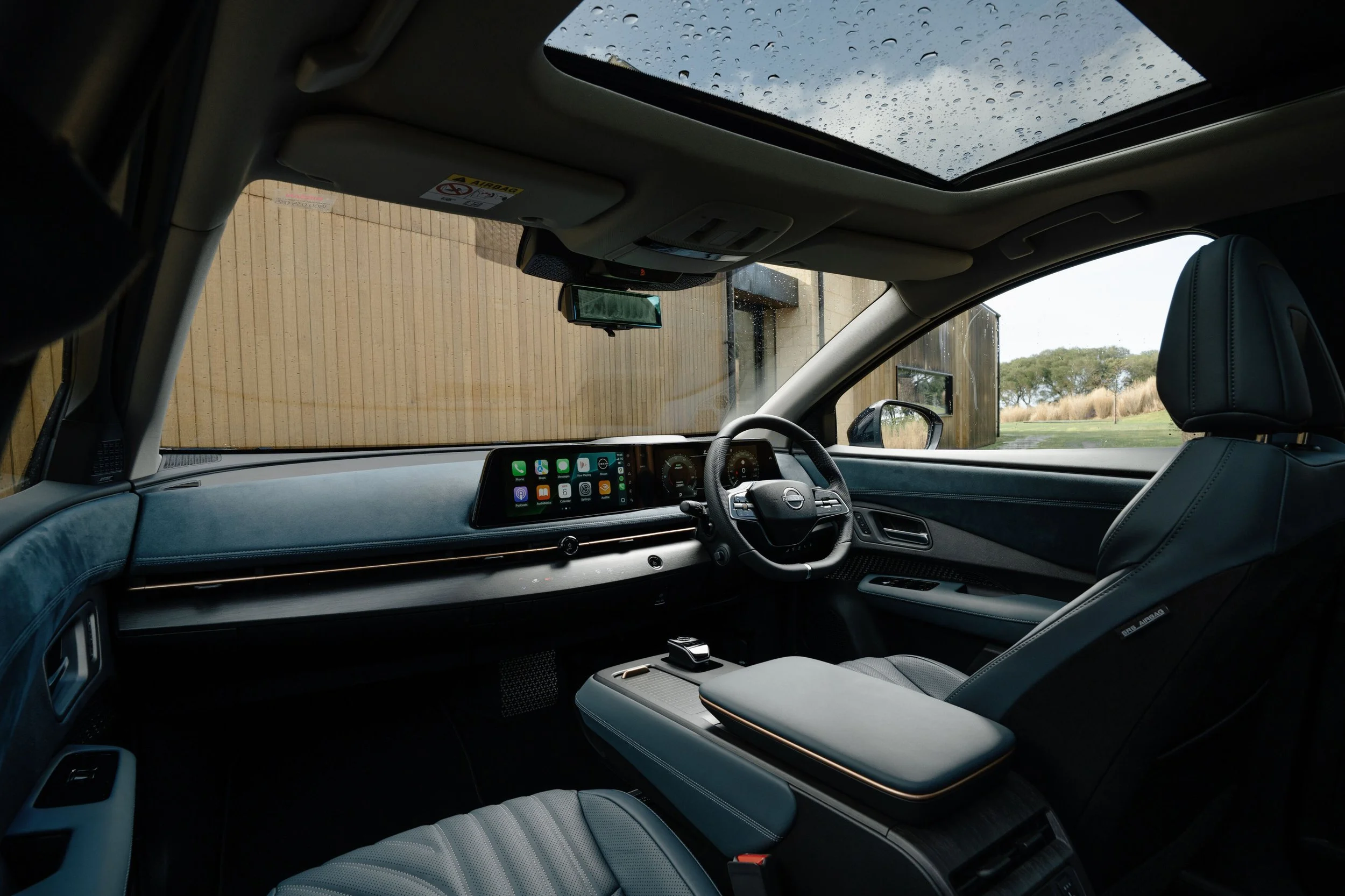
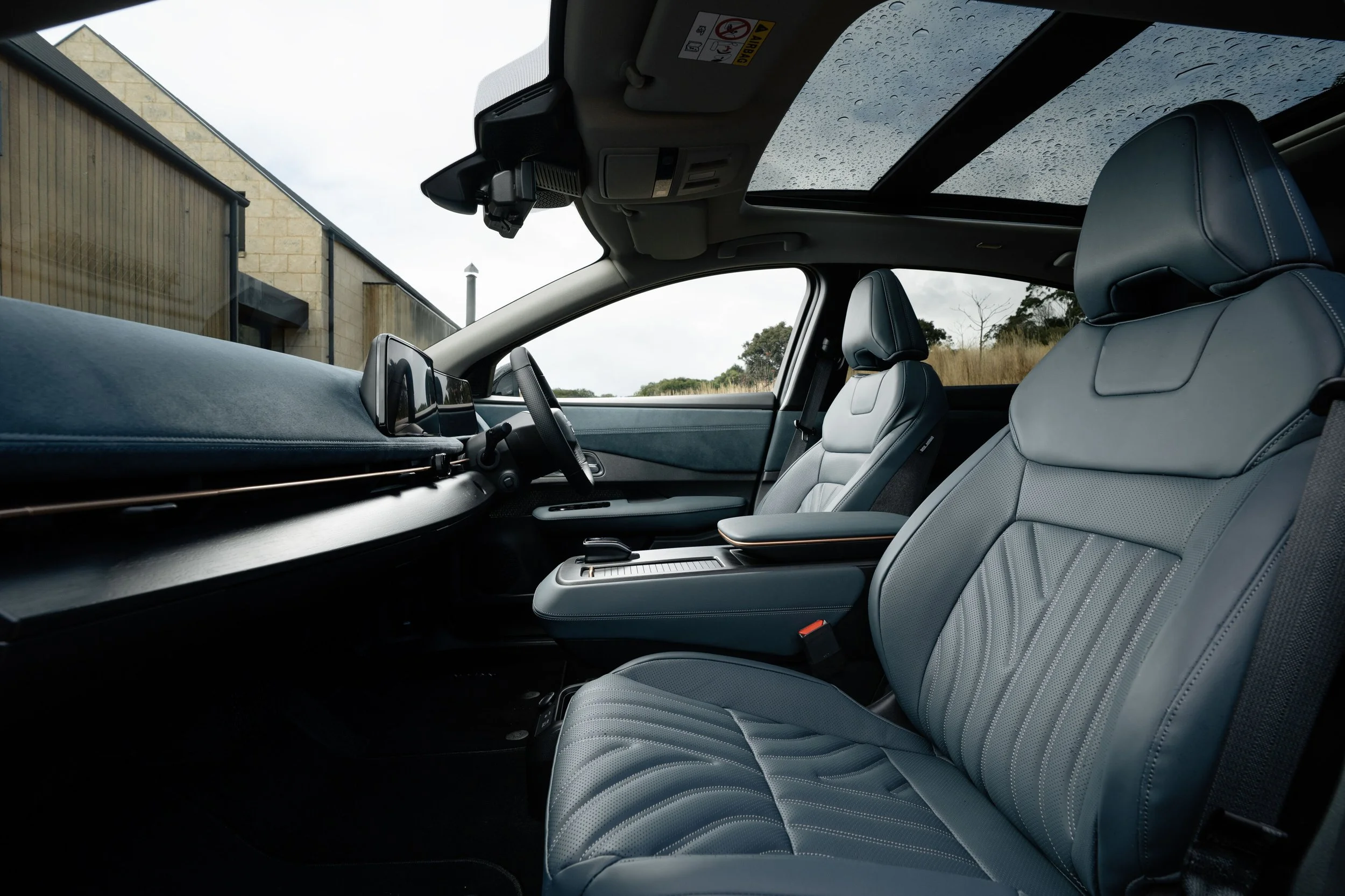
This might be my favourite part of the Ariya.
Because Nissan has actually done something interesting in here.
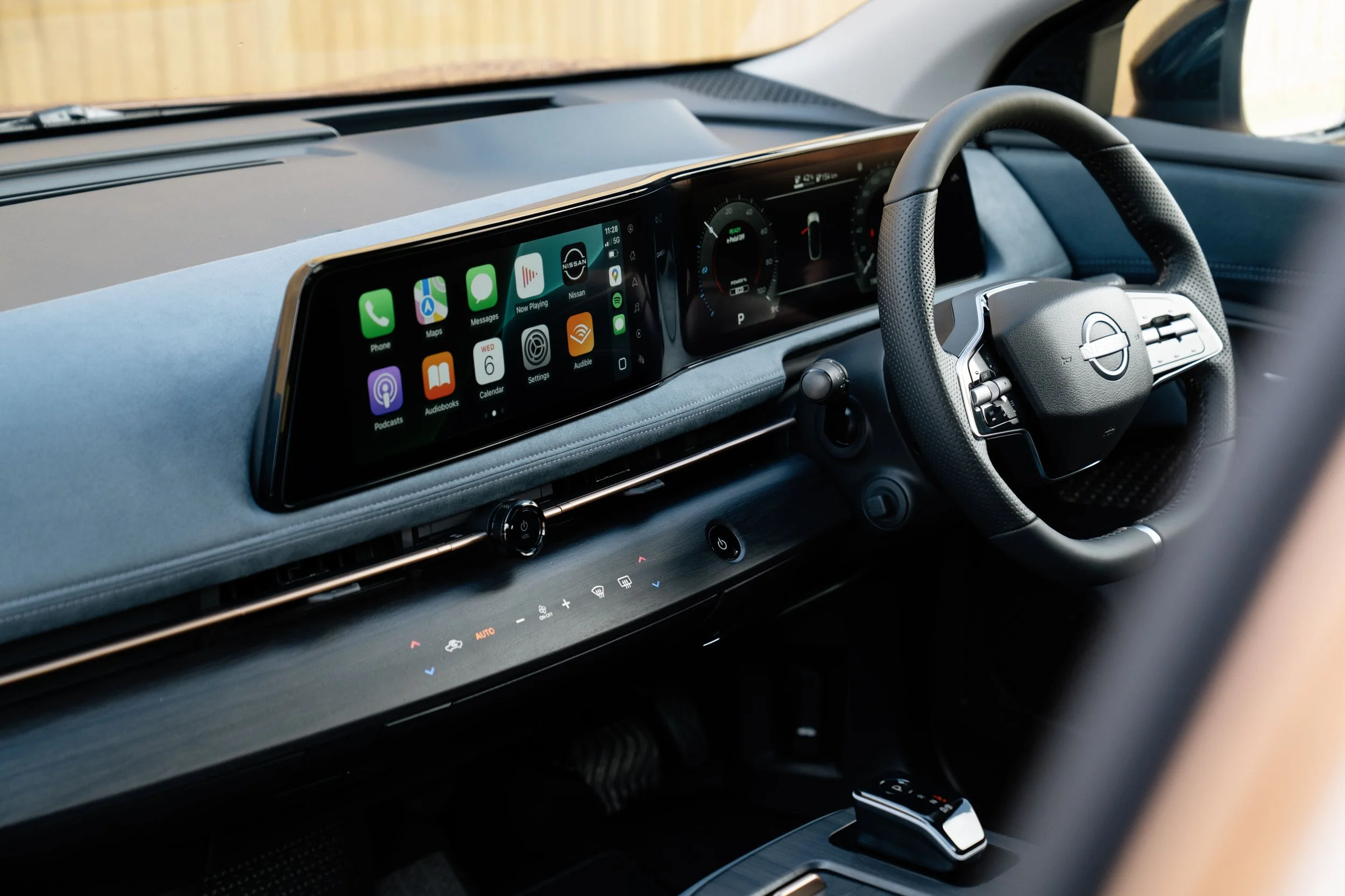
The dashboard is wonderfully minimalist, with twin 12.3-inch displays sitting across the driver's field of vision and a broad horizontal panel stretching across the cabin.
But look closer and you'll find something unusual.
The climate controls are integrated directly into the dashboard trim.
They're haptic controls.
Which means there aren't conventional physical buttons.
Now, regular readers will know where The Driver's Briefing generally stands on this subject.
We like buttons.
We like knobs.
We enjoy adjusting the temperature without taking our eyes off the road.
So Nissan was dangerously close to receiving a strongly worded paragraph.
But these controls remain permanently positioned where you expect them to be and provide physical feedback when pressed.
You don't need to open a climate app.
You don't need to swipe through three menus.
You don't need to ask a voice assistant to demist the windscreen.
So...
Thank you, Nissan.
We'll allow it.
Just this once.
The rest of the cabin is genuinely lovely.
And the Evolve gets the good stuff.
There's Nappa leather with Ultrasuede inserts, heated and ventilated front seats, heated rear seats, a head-up display, panoramic glass roof and Nissan's clever power-sliding centre console.
There's also a 10-speaker Bose audio system.
But the equipment isn't really what makes the interior work.
It's the atmosphere.
There's a completely flat floor, while the dashboard sits relatively far forward, creating an unusual amount of open space between the occupants.
And there's a distinctly Japanese influence to the whole thing.
Not Japanese in the sense of screens and technology.
Japanese in the sense of restraint.
The shapes are simple.
The lighting is subtle.
Nothing feels particularly desperate to impress you.
It just feels calm.
That's a quality more luxury manufacturers could learn from.
Practicality
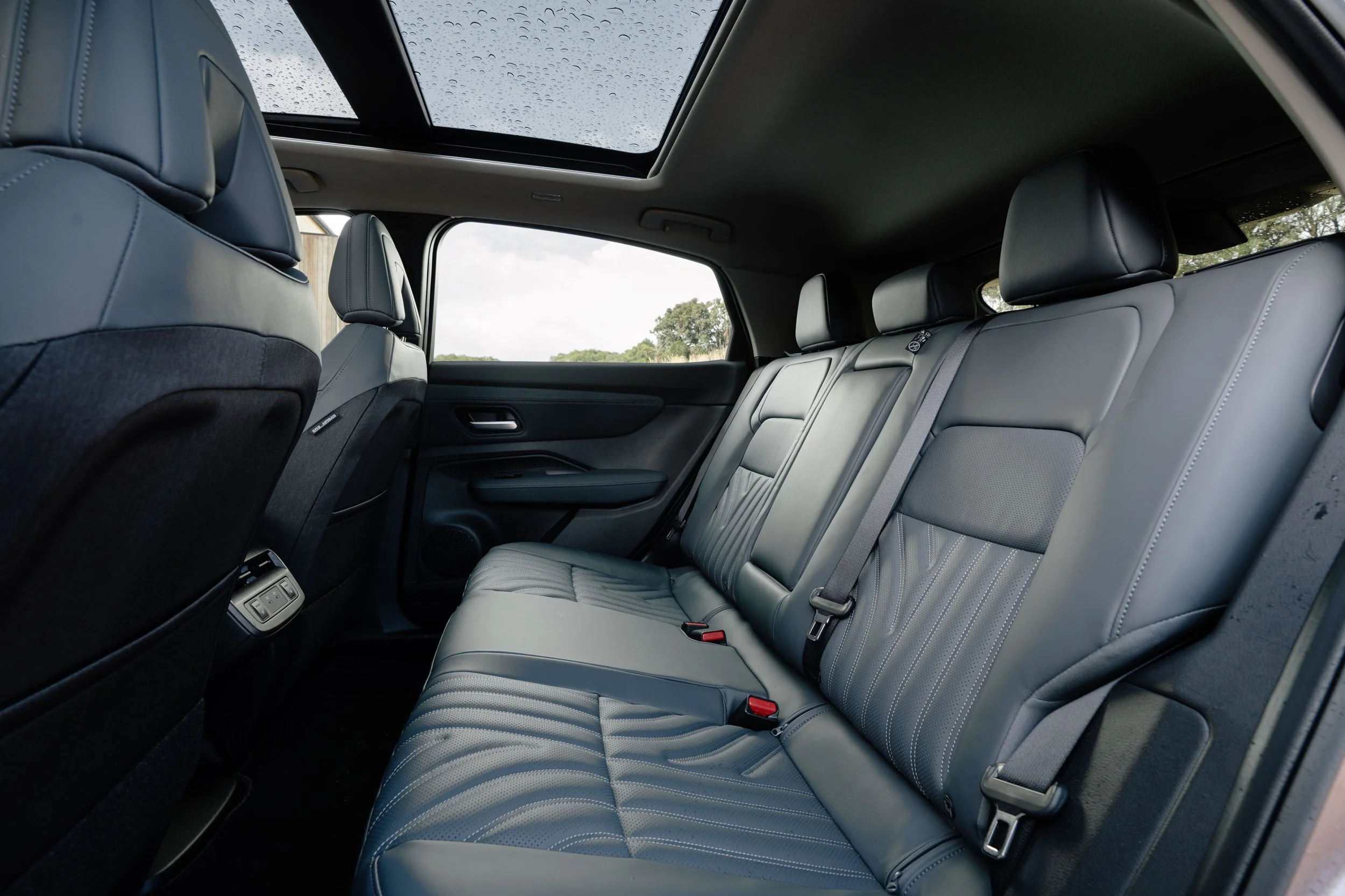
The 2,775mm wheelbase and flat floor translate into excellent rear-seat accommodation.
There's plenty of legroom, and without a transmission tunnel running through the centre, the middle passenger isn't forced to sit with a foot in each postcode.
The Evolve does lose a little luggage capacity compared with the front-wheel-drive Ariya models because of its additional drivetrain hardware.
There's 408 litres behind the rear seats, expanding to 1,280 litres when they're folded.
That's not enormous for an SUV of this size.
But it's perfectly usable.
And importantly, the cabin itself feels considerably more spacious than those boot figures might suggest.
Driving
This is where the Evolve starts earning its place at the top of the range.
Because 290kW and 600Nm is plenty.
Put your foot down and the Ariya responds immediately.
No gearbox.
No waiting for boost.
No engine searching for the right part of its rev range.
Just torque.
And quite a lot of it.
The 5.6-second 0-100km/h time tells part of the story, but it's the effortless mid-range acceleration that's more relevant in everyday driving.
See a gap?
You're there.
Need to overtake?
Done.
Motorway merge?
What motorway merge?
But Nissan hasn't tuned the Evolve to feel like some enormous electric hot hatch.
And that's important.
The power is strong without being stupid.
Progressive rather than violent.
You can use it without warning your passengers to brace themselves first.
Thank you, Nissan.
Nobody needs their groceries experiencing launch control.
e-4ORCE
Then there's that slightly strange name.
e-4ORCE.
Capital letters and numbers within words normally make me suspicious.
But underneath the marketing department's handiwork is some genuinely clever engineering.
Nissan's dual-motor system doesn't simply provide more power and all-wheel-drive traction.
It constantly manages torque delivery and regenerative braking across both axles to improve stability and body control.
The goal isn't necessarily to make the Ariya feel aggressive.
It's to make it feel composed.
And it works.
There's a reassuring planted quality to the Evolve that the front-wheel-drive versions can't quite replicate.
Accelerate hard out of a corner and both axles simply get on with the job.
Wet road?
Again, it just gets on with it.
There's even a dedicated Snow mode, although its usefulness will depend considerably on which part of Australia you call home.
Darwin residents may safely ignore that button.
The steering itself is light enough around town but gains some welcome weight as speeds increase.
And despite the Ariya Evolve weighing more than 2.2 tonnes, the low-mounted battery and near-even weight distribution mean it never feels quite as cumbersome as the number suggests.
It's not pretending to be a sports car.
It's simply a very competent, very quick electric SUV.
That's enough.
Comfort
And this is perhaps where the Ariya makes its strongest argument.
It's quiet.
Really quiet.
Obviously, there's no engine up front.
But removing an engine doesn't automatically make a car refined.
Tyre roar suddenly becomes more noticeable.
Wind noise becomes obvious.
Suspension noises you would previously never hear begin announcing themselves.
Nissan has clearly understood that.
At highway speeds, the Ariya remains impressively subdued.
The seats are excellent.
The suspension deals with ordinary Australian road surfaces without unnecessary harshness, despite the Evolve's larger 20-inch wheels.
And the overall experience is one of calmness.
That word keeps coming up with this car.
Calm.
Which is interesting considering there's 600Nm waiting underneath your right foot.
e-Pedal
Nissan also deserves some recognition because it has been experimenting with one-pedal-style driving longer than many manufacturers.
The Ariya's e-Pedal Step system increases regenerative braking when you lift off the accelerator, reducing how frequently you need to move your foot across to the brake pedal.
Once you become accustomed to regenerative driving, it becomes remarkably intuitive.
Accelerate.
Lift slightly to slow.
Lift further to slow more.
Use the brake pedal when required.
It's one of those EV features that initially sounds like a gimmick and then becomes completely normal within about twenty minutes.
Go back to a conventional car afterwards and you'll occasionally lift off the accelerator expecting something to happen.
It doesn't.
And then you remember.
Range and Charging
This is where the Ariya's age begins to show slightly.
The 487km WLTP range is respectable.
For most owners, it's more than enough.
Home charging means the Ariya can simply be plugged in overnight and begin the following morning with whatever charge limit you've selected.
Longer journeys shouldn't present any enormous problems either.
But the 130kW maximum DC charging speed is no longer particularly impressive.
Nissan says the 87kWh Ariya variants require around 45 minutes to charge from 10 to 80 per cent under suitable conditions.
Forty-five minutes isn't disastrous.
Have lunch.
Grab a coffee.
Question why service-station sausage rolls now cost approximately the same as residential property.
You'll survive.
But we've just driven vehicles from Hyundai and Kia using 800-volt architectures capable of completing similar charging stops considerably faster.
And that's perhaps the clearest reminder that Australia received the Ariya later than we should have.
The car still feels modern.
The charging hardware doesn't feel quite as modern as the very best.
Technology
The twin 12.3-inch screens dominate the dashboard, but Nissan has resisted turning the Ariya into a rolling electronics demonstration.
There's wireless Apple CarPlay and Android Auto, wireless phone charging, navigation and Nissan's suite of connected functions.
The Evolve also receives the 10.8-inch head-up display, which is exactly where useful information belongs:
In your line of sight.
There's also Nissan's Intelligent Around View Monitor.
And in tight car parks, you'll appreciate it.
Because while the Ariya isn't enormous, modern parking spaces appear to have been designed around the dimensions of a 1997 Suzuki Swift.
Nissan's ProPILOT driver-assistance system combines adaptive cruise functionality with lane assistance to reduce workload on longer journeys.
Again:
Technology working quietly in the background.
Helping.
That's how it should be.
Safety
The Ariya carries a five-star ANCAP safety rating from its 2022 assessment and includes the comprehensive active-safety equipment expected from a modern family EV.
There's autonomous emergency braking, lane assistance, blind-spot monitoring, rear cross-traffic technology and adaptive cruise functionality.
Seven airbags are fitted.
Nothing particularly surprising.
Which is exactly what you want from the safety section of a family SUV review.
Ownership
The electric drivetrain naturally eliminates many of the maintenance items associated with combustion-powered vehicles.
No oil changes.
No spark plugs.
No exhaust.
No conventional gearbox.
And regenerative braking can reduce wear on the physical brake components.
The Evolve's larger battery also makes it considerably easier to recommend as an only vehicle than the shorter-range Ariya variants.
Nearly 500km of claimed range won't completely eliminate charging considerations on an interstate trip.
But for everyday Australian life?
It's plenty.
And there's something reassuring about buying an EV from a manufacturer that was mass-producing them while some current electric-car companies were still PowerPoint presentations.
Nissan has been doing this for a while.
Even if Australia had to wait far too long for this particular one.
The Competition
And that's the problem.
Because while Nissan was waiting to bring the Ariya here, everybody else got busy.
There's the Tesla Model Y.
The Hyundai IONIQ 5.
The Kia EV5.
The BYD Sealion 7.
The Skoda Enyaq.
And an increasingly enormous collection of electric SUVs competing for roughly the same buyers.
Some charge faster.
Some travel further.
Some offer considerably more performance.
Others aggressively undercut the Nissan on price.
So the Ariya Evolve can't simply turn up and announce that Nissan now makes an electric SUV.
That would have worked five years ago.
Not anymore.
Fortunately, the Ariya has another argument.
Refinement.
The interior is excellent.
The ride is good.
The performance is effortless.
The e-4ORCE system gives it impressive composure.
And the entire vehicle has a maturity that suggests Nissan's experience with EVs wasn't wasted.
It's not trying to win the specification-sheet Olympics.
It's trying to be a good car.
There's something refreshing about that.
Verdict
The Nissan Ariya Evolve leaves me with one overriding question.
Why did Australia have to wait so long?
Because there's fundamentally an awful lot to like here.
It's handsome.
Comfortable.
Quiet.
Fast.
Spacious.
Beautifully finished.
And with 290kW, 600Nm and dual-motor all-wheel drive, the flagship Evolve has enough performance to make things entertaining without turning every traffic-light departure into an amusement-park ride.
The e-4ORCE system is clever.
The interior is genuinely distinctive.
And the 487km range makes it realistic as an everyday family vehicle.
The problem isn't really the Ariya.
It's time.
While Nissan was waiting, everybody else caught up.
Then some of them overtook.
The 130kW charging speed is the obvious example.
But specifications aren't everything.
Spend a week living with a car and you're not constantly thinking about its maximum DC charging rate.
You're thinking about whether the seat is comfortable.
Whether the ride is good.
Whether the controls annoy you.
Whether your family fits.
Whether you actually enjoy getting into it every morning.
And on those measures, the Ariya gets an awful lot right.
Nissan helped introduce ordinary people to electric cars more than fifteen years ago.
With the Ariya Evolve, it finally has the sophisticated electric SUV to match that history.
We're glad you're here, Nissan.
Next time?
Maybe don't make us wait quite so long.