
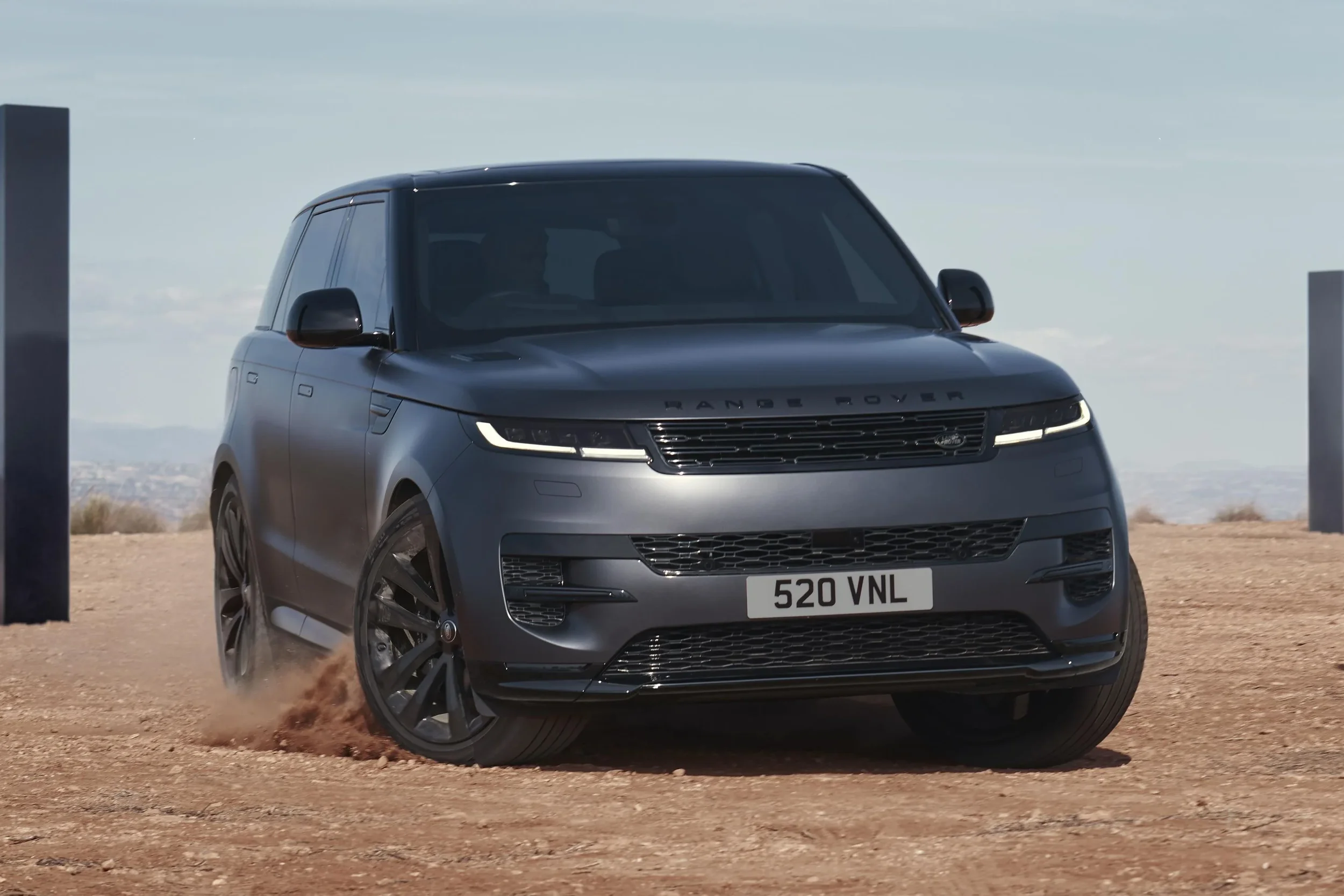
There are some cars you understand before you ever drive them.
A Porsche 911 is about the way it drives. A LandCruiser is about durability. A Toyota Camry is about dependability.
And then there are cars where you think you understand the appeal — until you actually spend time in one.
That was me with the Range Rover Sport.
Within probably thirty seconds of climbing into the P460e Dynamic HSE for the first time, I had one very simple thought:
I get it now.
I get why people love these things.
Because for all the discussion around Range Rovers — the styling, the image, the pricing and occasionally the ownership reputation — there is something they do exceptionally well that doesn't really translate through a brochure.
They make you feel incredibly comfortable.
Not merely in the physical sense, although the seats are superb. There is an overall sense of calmness to the Range Rover Sport. The way it isolates you from the road. The way the controls operate. The seating position. The materials. The almost complete absence of effort required to simply travel somewhere.
It feels expensive in a way that goes much deeper than having leather on the dashboard.
And after spending time with the plug-in hybrid P460e, I began to understand why Range Rover has developed such a fiercely loyal following.
Price and Key Specifications:
The Range Rover Sport P460e Dynamic HSE sits firmly in premium-SUV territory, priced at around $181,000 before on-road costs in MY26 specification.
Under the bonnet is Jaguar Land Rover's familiar 3.0-litre turbocharged inline-six petrol engine, supported by a substantial electric motor and 38.2kWh battery pack.
Combined output is 338kW, sent through an eight-speed automatic transmission and full-time four-wheel-drive system. The result is 0-100km/h in a claimed 5.4 seconds.
That's properly quick for something weighing around 2.6 tonnes.
The P460e can also operate as a genuine electric vehicle for shorter trips, rather than simply using the electric motor as occasional assistance. Official combined fuel consumption is consequently quoted at an almost comical-looking 1.6L/100km, although like every plug-in hybrid, real-world consumption depends enormously on how frequently you charge it.
On DC power, the battery can be replenished in around 40 minutes under ideal conditions.
Design:
There aren't many large SUVs that manage to look this clean.
Our test car was finished in white with a contrasting black roof, and it suited the Range Rover Sport almost perfectly.
Modern Range Rover design has become increasingly minimalist, and the Sport is arguably where that approach works best.
There is very little unnecessary decoration.
The door handles sit flush with the bodywork. The lighting is slim. The surfaces are largely uninterrupted. Even the rear of the vehicle hides much of its lighting within a gloss-black horizontal panel.
It looks substantial without looking cumbersome.
And unlike some rivals that seem determined to prove their expense through increasingly enormous grilles and complicated bodywork, the Sport is remarkably restrained.
There's a muscularity to it, certainly, particularly over the rear haunches, but there's also elegance.
You could park one outside a five-star hotel and it looks entirely appropriate.
You could also cover it in mud.
That's very much part of the Range Rover trick.
Interior and Practicality:
This is where the “I get it now” moment really happened for me.
You open the door, drop into the driver's seat and immediately understand that Range Rover has spent decades figuring out how to make people comfortable.
The driving position is excellent.
You sit relatively high, with a commanding view out over the bonnet, but it doesn't feel remotely truck-like. Instead, there is this wonderfully relaxed sense of being positioned above everything around you.
The seats themselves are outstanding.
Soft enough to immediately feel luxurious, but supportive enough that longer drives don't leave you sinking into them.
Then there is the general atmosphere.
It's quiet. It's beautifully put together. Most things you touch feel substantial and properly expensive.
The cabin isn't particularly flamboyant either.
A large 13.1-inch Pivi Pro touchscreen dominates the centre of the dashboard, while most of the remaining architecture is clean and horizontal.
Wireless Apple CarPlay and Android Auto are included, alongside wireless phone charging and the usual array of connected services.
There are moments where the pursuit of minimalism arguably goes slightly too far — particularly when functions that might once have had physical buttons require interaction with the screen — but the interface itself is one of the better systems currently offered by a luxury manufacturer.
There's plenty of room in the second row, too.
Adults can comfortably sit behind adults, and despite the Sport name, this remains a genuinely practical family SUV.
Boot capacity is a substantial 835 litres with the rear seats upright, expanding to 1,860 litres when they're folded.
So while the Range Rover Sport might spend plenty of its life outside cafés, offices and private schools, it hasn't forgotten that it's supposed to be useful.
Driving:
The strange thing about driving the P460e is that the headline performance figures tell you almost nothing about what makes it enjoyable.
Yes, 338kW is significant.
Yes, 0-100km/h in 5.4 seconds is quick.
But this isn't really a car that encourages you to continually prove either statistic.
Instead, it makes rapid progress feel effortless.
Pull away gently and the electric motor can move the Range Rover Sport in near silence.
Around town, that suits the car beautifully.
There is no vibration, no engine noise and very little intrusion from outside the cabin. You simply glide away.
Ask for more acceleration and the six-cylinder engine quietly joins proceedings, combining with the electric motor to deliver a strong, almost relentless surge of torque.
It never feels frantic.
That's important.
Some performance SUVs constantly remind you how fast they are. The Range Rover Sport just seems to gather speed without making much of a fuss about it.
And there is something wonderfully satisfying about that.
The eight-speed automatic generally disappears into the background, while the air suspension does an exceptional job of isolating occupants from poor road surfaces.
This is perhaps the defining characteristic of the car.
It rides beautifully.
Even on large wheels, there's a softness to the initial suspension response that rounds off bumps rather than crashing through them.
But the clever part is that it doesn't subsequently float around like an old luxury barge.
Through faster corners, the Sport controls its considerable mass remarkably well.
You'll never forget you're piloting something weighing more than 2.5 tonnes, but there's far less body movement than you might expect.
The steering is light enough around town while remaining accurate at speed, and visibility is excellent.
It's an exceptionally easy car to drive.
And that, again, becomes part of the appeal.
You finish a long journey feeling as though you've exerted almost no effort whatsoever.
But It's Still a Range Rover:
One of the easiest mistakes to make with modern Range Rovers is assuming they've become luxury vehicles that merely retain some historic association with off-roading.
They haven't.
Underneath the leather and enormous touchscreen remains a remarkably capable four-wheel-drive system.
The Sport retains dual-range four-wheel drive, electronic air suspension and Land Rover's Terrain Response systems, while the P460e is rated to wade through up to 900mm of water.
It also has a 3,000kg braked towing capacity.
Will most P460e owners ever test the limits of those capabilities?
Probably not.
But there's something satisfying about knowing they're there.
A luxury SUV that can quietly commute to work on electricity during the week and then genuinely venture deep into the Australian countryside on the weekend remains a fairly compelling proposition.
Safety:
The current Range Rover Sport carries a five-star ANCAP safety rating, awarded in 2022.
There's a comprehensive suite of active safety equipment including autonomous emergency braking, blind-spot monitoring, adaptive cruise control, lane-keeping assistance and a surround-view camera system.
Adaptive cruise control works particularly well with the relaxed personality of the vehicle.
Set the speed, settle into those enormous seats and the Range Rover Sport becomes the sort of vehicle that could effortlessly consume hundreds of kilometres in a day.
Ownership:
This is traditionally where the Range Rover conversation becomes slightly more complicated.
Land Rover now offers a five-year, unlimited-kilometre warranty, along with five years of roadside assistance.
That brings the brand broadly into line with the expectations of the modern Australian premium market.
And as a plug-in hybrid, the P460e makes the most sense for someone who can charge regularly.
If your daily commute falls within the vehicle's electric operating range and you plug it in each evening, there's genuine potential to complete a significant portion of everyday driving without using much petrol at all.
If you never plug it in, however, you're essentially carrying a large battery around while asking a petrol engine to move a 2.6-tonne luxury SUV.
As always with a PHEV, the owner determines whether the technology makes sense.
Verdict:
Before driving the Range Rover Sport, I understood why people bought them.
Or at least I thought I did.
They looked good.
They had presence.
They carried a certain prestige.
But none of those things quite explain the loyalty these cars create.
Spend some proper time behind the wheel and it begins to make considerably more sense.
It's the comfort.
It's the silence.
It's the seating position.
It's the way it floats through traffic without feeling disconnected.
It's the effortless performance.
It's the fact that after a long drive you climb out feeling considerably less tired than you probably should.
And it's the strange sense that whatever chaos might be happening outside the windows simply isn't particularly important anymore.
There are faster SUVs.
There are sharper SUVs.
There are cheaper SUVs.
There are undoubtedly SUVs that will make a stronger argument on a spreadsheet.
But very few combine luxury, genuine off-road ability, performance and outright serenity in quite the same way.
The P460e arguably strengthens that formula even further.
Electric driving suits a Range Rover almost perfectly, because silence and effortless torque were already fundamental parts of the experience.
Which brings me back to the thought I had almost immediately after climbing aboard.
I get it now.
And perhaps that's the strongest compliment I can give it.