
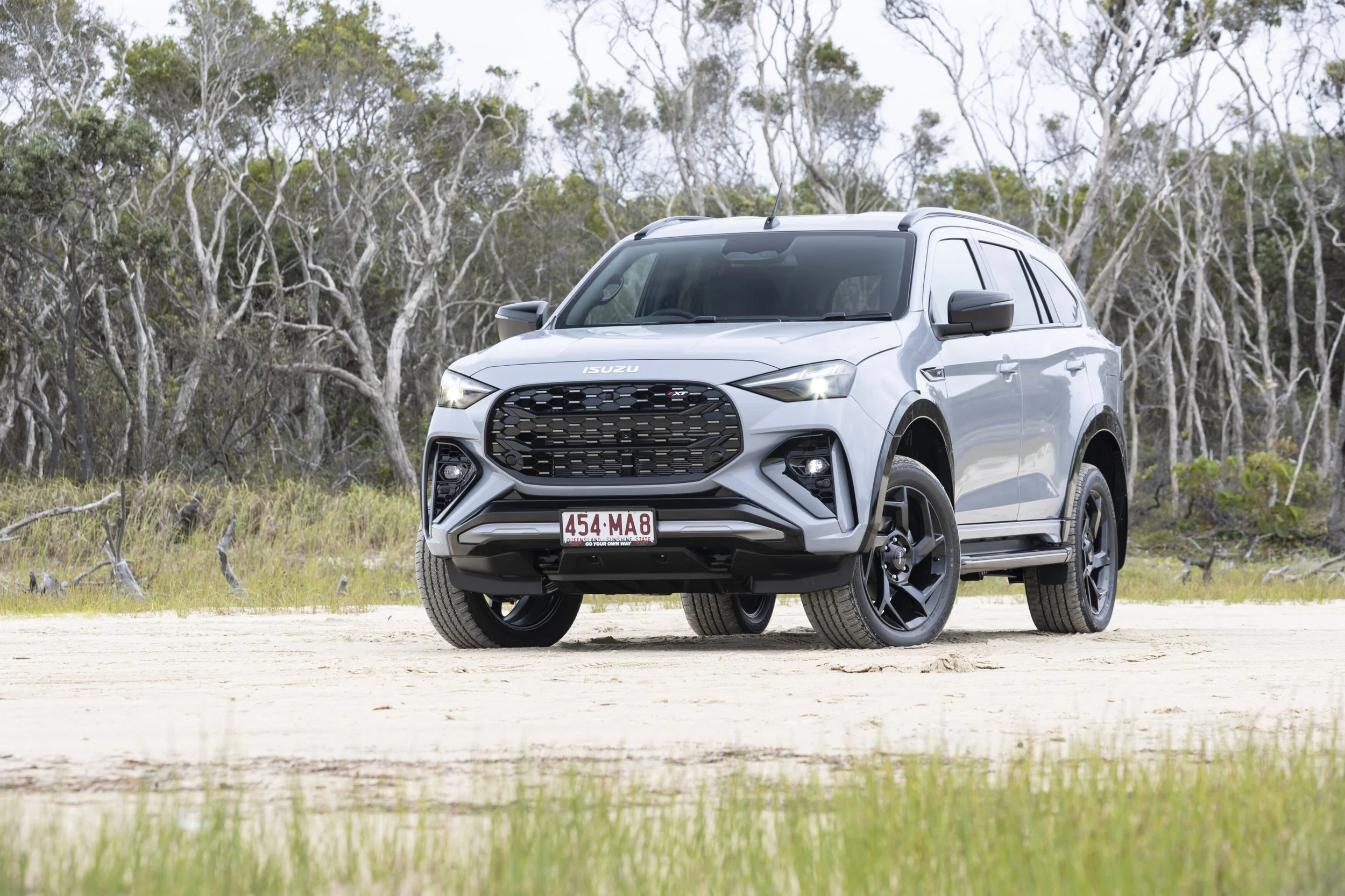
There is something refreshingly honest about an Isuzu MU-X.
It has never pretended to be a sports car.
It has never tried particularly hard to be a luxury SUV.
And nobody at Isuzu appears to have woken up one morning and decided what Australian families really need is a 500kW twin-turbo V8 and a Nürburgring lap time.
The MU-X has traditionally had a much simpler job.
Fit seven people.
Tow something heavy.
Go a very long way.
And preferably keep doing all of that for years without causing its owner too many headaches.
Now, however, Isuzu has decided its family 4WD could use a little more attitude.
Enter the 2026 Isuzu MU-X X-Terrain.
Sitting above the familiar LS-T, the X-Terrain becomes the new flagship of the MU-X range and brings with it tougher styling, additional equipment and some genuinely worthwhile hardware underneath.
But importantly, Isuzu hasn't attempted to reinvent the MU-X in the process.
This is still fundamentally the same honest, diesel-powered, body-on-frame seven-seat 4WD Australians have embraced for years.
It has just put its good shirt on.
And some considerably better suspension.
Price and Key Specifications:
The MU-X X-Terrain sits at the top of the 2026 range, priced from $73,990 before on-road costs.
Under the bonnet is Isuzu's familiar 3.0-litre four-cylinder turbo-diesel, producing 140kW and 450Nm.
Those outputs are sent through a six-speed automatic transmission to a selectable four-wheel-drive system incorporating high and low range.
No hybrid assistance.
No 48-volt mild-hybrid system.
No complicated dual-clutch transmission.
Just a big diesel engine, a conventional automatic gearbox and proper four-wheel drive.
There is something increasingly old-school about that combination.
And in an MU-X?
That's not necessarily a criticism.
The X-Terrain also retains the MU-X's 3,500kg braked towing capacity, which remains one of the biggest reasons buyers gravitate towards vehicles like this in the first place.
But the really interesting changes aren't under the bonnet.
They're underneath the car.
Design:
Let's be honest.
The regular MU-X isn't exactly an unattractive vehicle.
But the X-Terrain looks considerably better.
Isuzu has resisted the temptation to simply throw an enormous collection of accessories at it and call the job done.
Instead, there are darker exterior elements, unique badging, blacked-out trim and 20-inch alloy wheels, giving the flagship a noticeably more purposeful appearance.
The front end in particular has genuine presence.
There's enough aggression to differentiate it from the family-focused versions without turning it into some sort of post-apocalyptic cosplay exercise.
And that's appreciated.
Because there seems to be an unwritten rule amongst manufacturers at the moment that anything remotely associated with off-roading must look as though it's preparing to invade a small country.
The X-Terrain doesn't.
It just looks tough.
There's a difference.
The black exterior treatment works particularly well against some of the brighter paint colours, while X-Terrain branding provides enough distinction that MU-X enthusiasts will immediately know you've bought the expensive one.
Whether anyone else will notice is another question.
But you'll know.
And sometimes that's enough.
Interior and Practicality:
Inside, things remain unmistakably MU-X.
That's both a compliment and perhaps one of the areas where Isuzu's flagship still trails some newer competitors.
The fundamental layout is straightforward and easy to understand.
There are physical controls for important functions.
The climate controls don't require three touchscreen menus and a university degree to operate.
Thank you, Isuzu.
Ahead of the driver sits a digital instrument display, while infotainment duties are handled by a 9.0-inch central touchscreen incorporating wireless Apple CarPlay and Android Auto.
There's also wireless phone charging and the expected collection of USB connections.
X-Terrain models receive unique interior treatments designed to give the cabin a little more personality, and there's enough leather and soft-touch material around the important areas to remind you that this is the flagship.
But nobody is going to climb from a Range Rover into the MU-X and wonder where the extra money went.
That's not what this car is trying to achieve.
Instead, the interior feels robust.
Like it was designed with the understanding that somebody will eventually climb into it wearing muddy shoes.
For an adventure-focused family SUV, that's arguably more important.
The first two rows offer plenty of room, while the third row remains genuinely useful for children and acceptable for adults over shorter journeys.
And this is where the MU-X continues to make a strong argument for itself.
It's a proper seven-seater.
Not a five-seat SUV with two emergency chairs hidden underneath the boot floor.
With all three rows in use, luggage capacity is naturally reduced, but fold the third row away and the MU-X becomes an impressively useful family hauler.
School bags during the week.
Camping gear on Friday.
A trailer behind it on Saturday.
That's basically the MU-X job description.
Driving:
Start the 3.0-litre diesel and there's absolutely no confusion about what's happening underneath the bonnet.
It's a diesel.
You can hear it.
You can occasionally feel it.
And Isuzu doesn't appear particularly interested in pretending otherwise.
But once underway, the big four-cylinder settles down nicely.
The 450Nm torque peak arrives low in the rev range, meaning the MU-X rarely needs to be worked particularly hard in everyday driving.
Around town, the six-speed automatic generally keeps the engine operating within its useful torque band, while on the highway the drivetrain settles into the kind of relaxed rhythm these vehicles are designed for.
Would another 50Nm be welcome?
Absolutely.
Nobody has ever climbed out of a diesel 4WD and complained that it had too much torque.
Particularly when towing.
But outright performance has never really been the MU-X's mission.
The more important development with the X-Terrain is the suspension.
Isuzu has fitted the flagship with remote-reservoir monotube dampers, developed specifically to improve body control both on and off-road.
And this is exactly the sort of upgrade we like to see on an adventure-focused flagship.
Not another ambient lighting colour.
Not an illuminated badge.
Actual mechanical hardware.
Excellent.
The result is an MU-X that feels more controlled over broken surfaces while retaining the durability and wheel travel expected from a proper body-on-frame 4WD.
There's still no disguising the underlying architecture.
You'll occasionally feel the body move independently over larger imperfections, particularly compared with a road-focused monocoque SUV.
But again, context matters.
That BMW X5 that rides beautifully through the suburbs isn't necessarily the thing you want dragging a three-tonne caravan down a corrugated dirt road several hundred kilometres from the nearest dealership.
The MU-X is.
Steering remains relatively light around town, making something of this size surprisingly easy to manoeuvre.
And once you're settled on the highway, the MU-X makes a very convincing long-distance touring companion.
Which is exactly where it needs to excel.
Off Road:
This is where the X-Terrain badge actually needs to mean something.
Fortunately, it does.
Underneath remains a proper selectable four-wheel-drive system with low range, while Isuzu's Rough Terrain Mode can electronically manage wheelspin and torque delivery when conditions become more challenging.
There's also a locking rear differential.
And with the X-Terrain's upgraded suspension, this isn't simply an appearance package designed for people who occasionally park on grass.
It can genuinely go off-road.
Ground clearance is generous, there's substantial wading capability, and the MU-X's relatively straightforward drivetrain remains one of its greatest strengths in remote Australia.
Sometimes simple is good.
Particularly when the nearest town is three hours away.
The suspension upgrade also makes considerably more sense here.
Remote-reservoir dampers can better manage heat during sustained operation over rough terrain, helping maintain damping performance when ordinary shock absorbers may begin to fade.
Will every X-Terrain owner need that?
Probably not.
Will plenty of them simply drive to school, Woolworths and the office?
Of course.
That's true of virtually every four-wheel drive sold in Australia.
But the capability is there for those who actually intend to use it.
And that's what matters.
Towing:
For many buyers, this section matters more than almost everything above it.
The MU-X X-Terrain maintains a 3,500kg braked towing capacity, placing it firmly amongst Australia's serious tow vehicles.
And while maximum towing figures should never be considered in isolation — payload, tow-ball mass and gross combination mass still need to be understood — the basic package is well suited to caravans, boats and trailers.
The 3.0-litre diesel's low-end torque helps here.
Again, we'd happily accept another serving of torque if Isuzu offered it.
But there's something reassuring about an engine that has been developed around commercial and heavy-duty applications rather than chasing impressive acceleration numbers.
The six-speed automatic is similarly conventional.
Six ratios might sound almost quaint when some rivals now offer eight or ten.
But more gears aren't automatically better.
For towing and remote touring, predictable behaviour and proven hardware count for a lot.
Safety:
The MU-X comes equipped with Isuzu's comprehensive suite of driver-assistance systems, including autonomous emergency braking, adaptive cruise control, blind-spot monitoring, rear cross-traffic alert and lane-keeping assistance.
There's also a surround-view camera system, which is genuinely useful in a vehicle this size — particularly when manoeuvring off-road or lining up a trailer.
Isuzu has continued refining its driver-assistance technology over the years, and that's important because these vehicles spend just as much time transporting children through suburbia as they do crossing the Australian outback.
Probably considerably more, actually.
Ownership:
And this is where the Isuzu proposition becomes particularly easy to understand.
The MU-X is backed by Isuzu UTE Australia's ownership program, incorporating a six-year/150,000km warranty when servicing requirements are met, alongside roadside assistance and capped-price servicing provisions.
But the bigger attraction is arguably less tangible.
Isuzu has built a substantial reputation in Australia around diesel commercial vehicles and 4WDs.
The MU-X shares much of its underlying DNA with the D-MAX ute, and that matters to buyers planning to tow, tour or travel into remote areas.
There's also an enormous aftermarket surrounding the platform.
Bullbars.
Snorkels.
Roof racks.
Suspension.
Long-range tanks.
Underbody protection.
Drawer systems.
If you can think of something you'd like to bolt onto an MU-X, somebody in Australia probably manufactures it.
Probably three companies, actually.
The Competition:
The seven-seat diesel 4WD segment remains fiercely competitive.
The obvious rivals include the Ford Everest, Toyota Fortuner, Mitsubishi Pajero Sport and related ute-based SUVs, while buyers spending X-Terrain money may also find themselves looking further upmarket.
The Everest is perhaps the most significant comparison.
Ford's latest-generation SUV feels more modern inside, offers stronger powertrain options and arguably delivers a more polished on-road experience.
The MU-X counters with simplicity, proven Isuzu diesel hardware and an enormous Australian owner and aftermarket ecosystem.
Then there's the Toyota.
Because there is always a Toyota.
The Fortuner follows a broadly similar recipe, although it's now one of the older vehicles in the segment.
And Mitsubishi's Pajero Sport continues to make a strong value argument despite also showing its age.
Where the X-Terrain becomes interesting is that Isuzu hasn't tried to win by transforming the MU-X into something it isn't.
Instead, it has taken the existing formula and added useful hardware to it.
That's a much smarter approach.
Verdict:
The MU-X X-Terrain isn't revolutionary.
And that's probably exactly why it works.
Isuzu hasn't attempted to reinvent its seven-seat 4WD.
It hasn't filled the dashboard with enormous screens.
It hasn't installed a tiny turbocharged petrol engine assisted by three electric motors.
And it hasn't decided the family adventure wagon desperately needs launch control.
Instead, Isuzu looked at what people already liked about the MU-X and asked a much more sensible question:
How do we make it better at being an MU-X?
The answer was tougher styling, more equipment and — most importantly — meaningful suspension hardware.
It's still a little agricultural in places.
The diesel could use more torque.
And some competitors undoubtedly feel more sophisticated on the road.
But there's an honesty to the MU-X that remains enormously appealing.
It feels built for the Australian lifestyle rather than merely marketed towards it.
Load the kids in.
Fill the boot.
Hook up the caravan.
Point it towards somewhere without phone reception.
And go.
That's what an MU-X is supposed to do.
The X-Terrain simply looks a little better doing it.
Thank you, Isuzu, for spending money on the suspension instead of another ambient lighting colour.