
Review: Genesis GV60 Advanced RWD
There is a problem with electric cars.
Apparently, none of them are allowed to be simply enough.
Every new EV seems to arrive with another increasingly ridiculous number attached to it. Three hundred kilowatts. Four hundred kilowatts. Five hundred kilowatts. Zero to 100km/h in four seconds. Three seconds. Two-point-something seconds.
Performance figures that, not particularly long ago, belonged exclusively to things wearing Lamborghini badges.
And that's impressive. Of course it is. But somewhere along the way, we've apparently decided that every family-sized electric vehicle needs enough acceleration to temporarily alter the position of your internal organs.
Which brings us to the 2026 Genesis GV60 Advanced.
It has one electric motor driving the rear wheels, producing 168kW and 350Nm, and takes 7.8 seconds to reach 100km/h.
In 2026 EV terms?
That almost sounds...
Slow.
Except after living with it, something strange happened.
I never really wanted more.
Enough
That's the word I kept coming back to.
Enough.
Put your foot down and the GV60 moves with the immediate smoothness we've come to expect from electric cars. There's no gearbox deciding what it wants to do, no engine waiting for boost and no revs to build. Just 350Nm arriving cleanly through the rear wheels.
Is it violent? No.
Does your passenger's phone disappear into the rear footwell every time you leave the lights? Probably not.
But it moves.
Put it into Sport mode and things sharpen slightly. The accelerator becomes more responsive, there's a little more urgency and you remember that the motor is driving the rear wheels.
But then something else happens.
You stop caring.
Because there's something about the atmosphere inside the GV60 Advanced that doesn't make you want to race anyone.
You sink into the seat. Everything becomes quiet. The cabin feels expensive, the suspension settles into its rhythm and you put some music on. Rather than searching through menus looking for the most aggressive setting available, you simply drive.
And suddenly 168kW feels completely adequate.
Not because the GV60 Advanced is secretly fast. It isn't. But because nothing about this particular version makes you feel like it needs to be.
Perhaps that's what a luxury EV should be.
Not constantly asking:
"Want to see how fast I am?"
But quietly asking:
"Are you comfortable?"
What's Changed?
Quite a lot, actually.
The updated GV60 returns to Australia with a substantially simplified range. At one end sits this, the GV60 Advanced. At the other sits something considerably more unhinged: the GV60 Magma.
We'll get to that one separately.
Trust us.
We're looking forward to it.
For now, the important thing is that the Advanced takes a very different approach from the GV60s Australians previously knew. The old range was all-wheel drive, while the new Advanced uses a single rear-mounted electric motor and rear-wheel drive.
It also receives a larger 84kWh nickel-manganese-cobalt battery, replacing the previous 77.4kWh unit, increasing range substantially in the process.
And perhaps most importantly?
It's cheaper.
Significantly cheaper.
Price
The 2026 Genesis GV60 Advanced starts at $88,300 before on-road costs.
Now, eighty-eight grand is still eighty-eight grand. Nobody is accidentally buying one while popping into Woolworths for milk.
But importantly, the updated Advanced is around $15,000 cheaper than the previous entry point into the GV60 range. That's substantial, and Genesis needed to do something because the electric vehicle market has changed extraordinarily quickly.
Chinese manufacturers have arrived with increasingly sophisticated EVs offering enormous screens, huge equipment lists, strong performance and competitive range for considerably less money. Meanwhile, established premium manufacturers including BMW, Audi, Mercedes-Benz and Lexus occupy the other side of the conversation.
Genesis therefore sits in an interesting position.
It can't simply be cheap.
It isn't.
Instead, it has to convince you that there's value in luxury.
And that brings us inside.
The Cabin
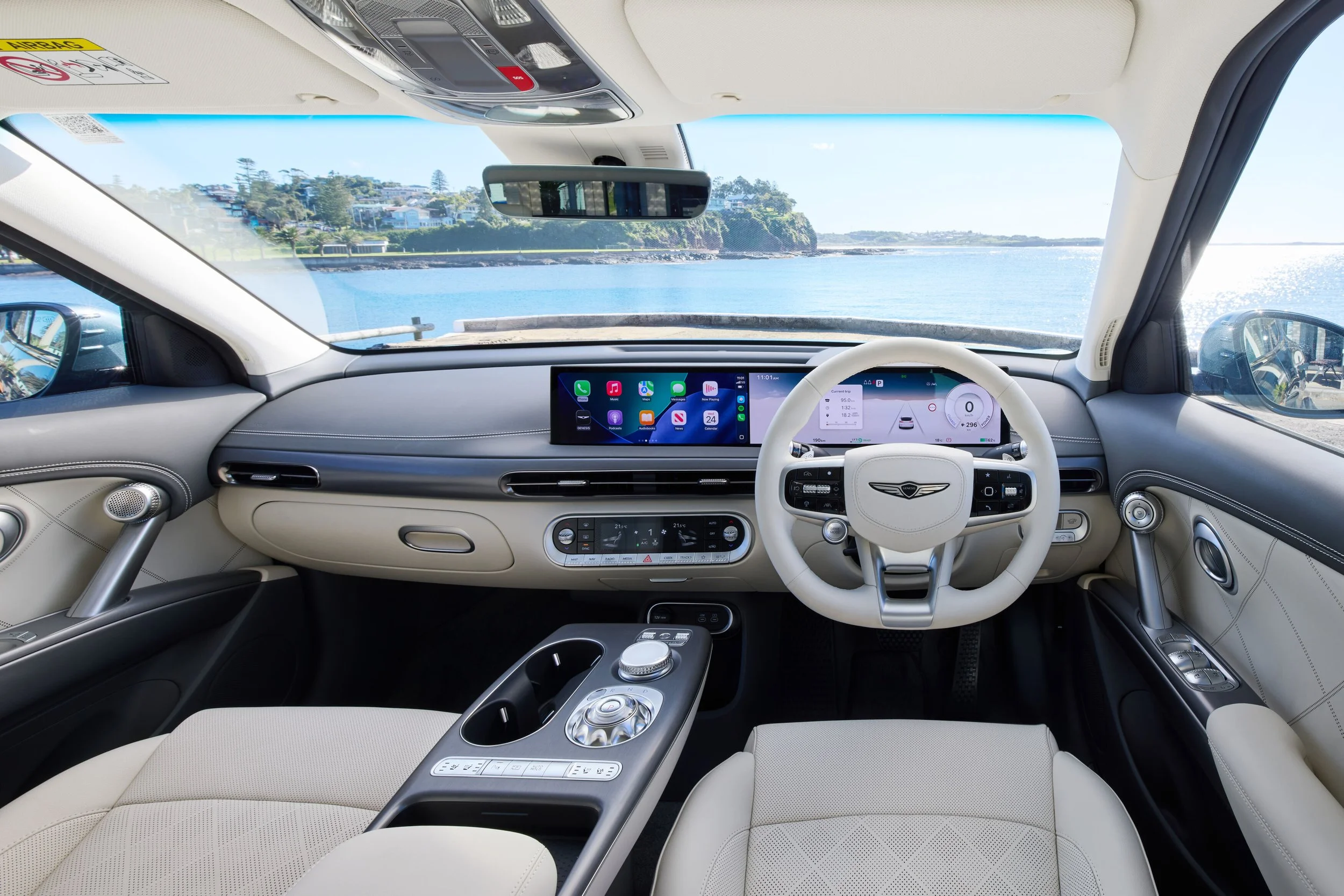
This is where the GV60 makes its strongest argument, because Genesis understands interiors.
We've said this before. We'll almost certainly say it again.
There are plenty of cars that give you enormous screens, ambient lighting, wireless charging and approximately eleven billion selectable colours for the interior illumination. But luxury isn't simply the number of things fitted to a car.
It's how the whole environment makes you feel.
And the GV60 feels...
Lovely.
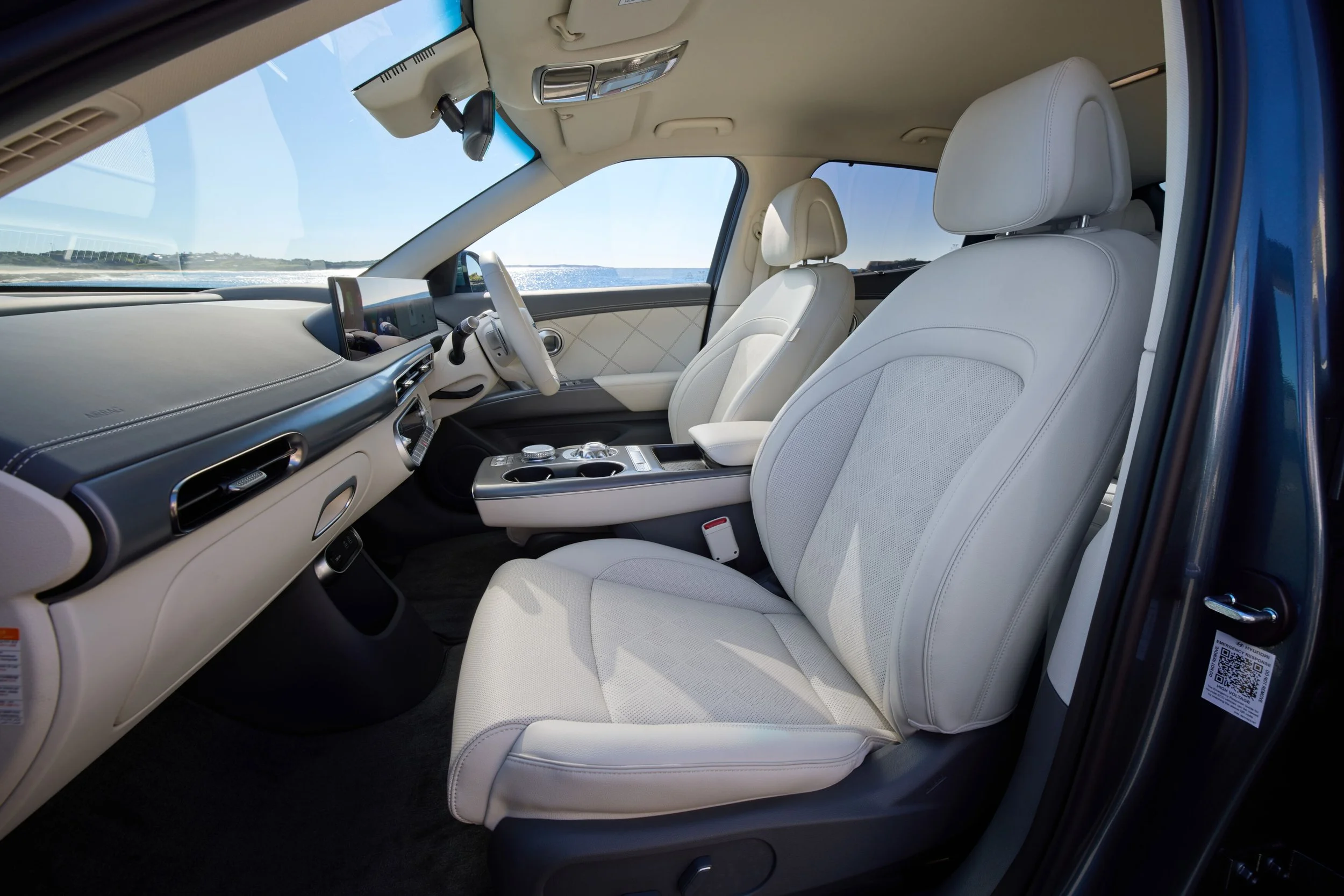
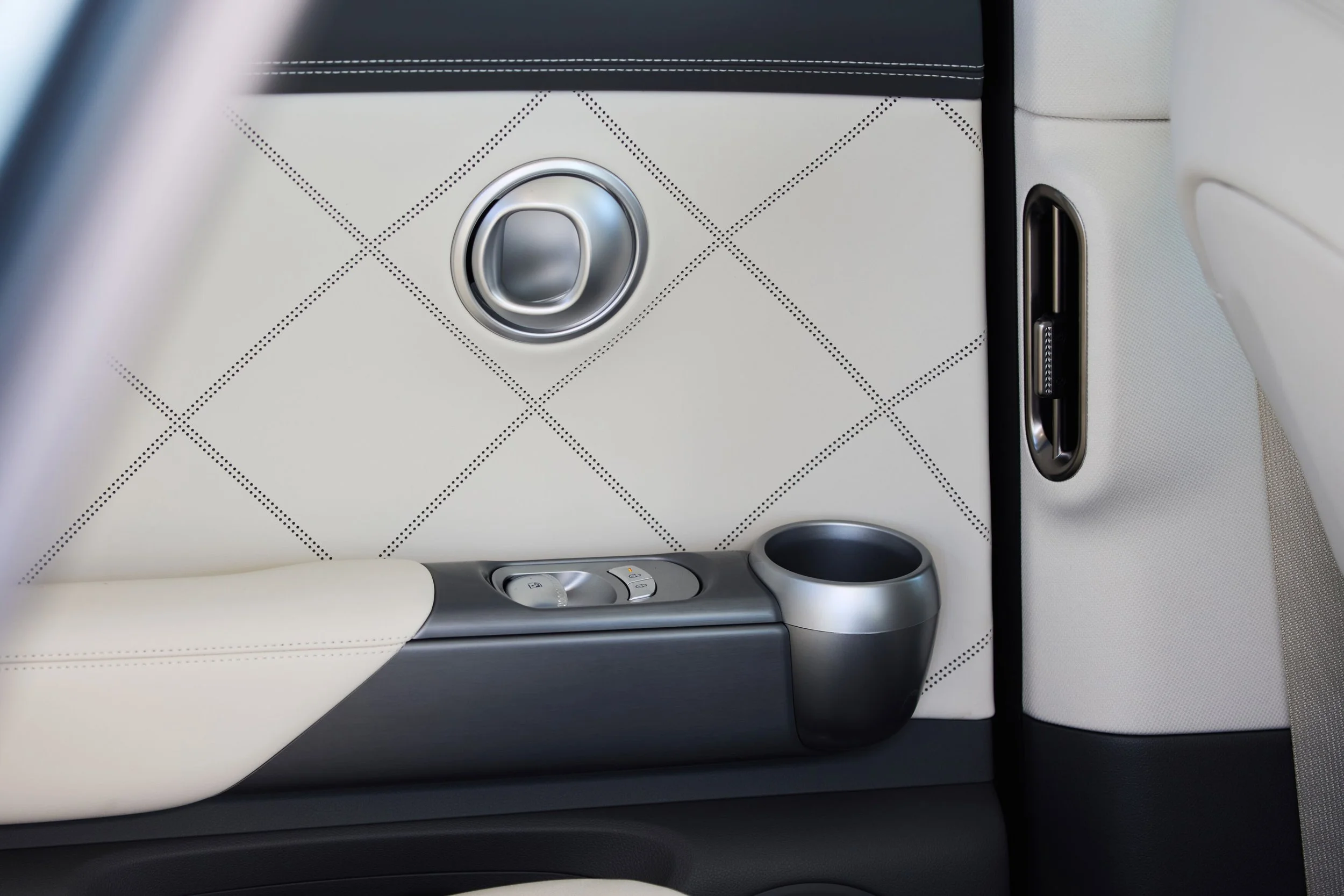
Soft-touch materials are everywhere. Leather runs across the dashboard and doors. There's interesting detailing rather than endless expanses of black plastic, the switchgear feels considered and the seats are genuinely comfortable.
More importantly, there's enough visual theatre to remind you that Genesis didn't simply take an ordinary Hyundai interior and replace the badge.
It feels different.
Special.
And, importantly, expensive.
The Crystal Sphere
Then there's this thing.
The Crystal Sphere.
Genesis could have fitted a conventional rotary gear selector. It would have worked perfectly well, occupied very little space and nobody would have complained.
Genesis apparently thought that sounded terribly boring.
So when the GV60 is switched off, a beautifully illuminated glass sphere sits in the centre console. Press the start button and the entire thing rotates through 180 degrees, disappearing into the console and presenting the rotary gear selector on its other side.
Necessary?
Absolutely not.
Do I like it?
Absolutely.
But perhaps the best endorsement came from my two young daughters.
They were fascinated by it.
Every time we got into the GV60 there was anticipation. Press the button, the sphere rotates, the gear selector appears and apparently starting Dad's test car is now an event.
Watching their reaction made me appreciate something about the GV60 that I'd probably have stopped noticing after a few days.
There's theatre here.
Not fake exhaust noises or some ridiculous launch sequence. Just a completely unnecessary little piece of mechanical choreography that makes starting the car feel slightly special.
That's what good luxury design sometimes is. Not something you need, but something that makes you smile precisely because you don't need it.
And if Genesis is ever tempted to delete the Crystal Sphere in the name of cost saving, my two tiny automotive consultants have voted.
Absolutely bloody not.
Thank you, Genesis.
Keep it.
Screens and Technology
The updated GV60 gets a huge 27-inch OLED panoramic display, combining the digital instrumentation and infotainment into one sweeping piece of glass.
Visually, it's excellent. Crisp, modern and beautifully integrated. That's important because we're currently going through an automotive phase where manufacturers seem to be competing over who can glue the largest television to a dashboard.
Genesis has at least made its screen feel like part of the interior.
There's satellite navigation, connected functionality, wireless Apple CarPlay and Android Auto, plus a wireless phone charger.
And yes.
Wireless Apple CarPlay.
Leapmotor C10, please take notes.
The GV60 also retains dedicated climate controls beneath the main display rather than forcing you to conduct a small archaeological expedition through touchscreen menus every time you'd like to change the temperature.
There are proper window switches, normal mirror controls and conventional indicator and wiper stalks.
Imagine that.
We've apparently reached the point where being able to operate a car without consulting a touchscreen deserves praise.
Thank you, Genesis.
Seats and Storage
Both front seats offer 12-way electric adjustment, along with heating and ventilation.
Australian summer?
Ventilated seats.
Cold winter morning?
Heated seats.
There are certain technologies humanity should now simply agree never to surrender. Cooled seats are one of them.
The updated Advanced has lost some of the luxuries previously available in the GV60, including the old 18-way driver's seat and Nappa leather, so part of that substantial price reduction has clearly come from somewhere.
But crucially, the cabin doesn't suddenly feel cheap because of it.
Not remotely.
Genesis has also thought about where your actual stuff goes. There's a floating-style centre console with useful storage beneath it, cupholders, large door bins, wireless charging and a decent centre-console compartment.
And instead of a conventional glovebox?
A drawer.
Pull it out. Put things in it. Push it closed.
Simple.
Useful.
Why don't more cars do this?
Rear Seats
The GV60 sits on Hyundai Motor Group's E-GMP electric architecture, with a long 2900mm wheelbase packed into a body measuring around 4515mm long, 1890mm wide and 1580mm tall.
Don't mistake this for a large SUV, though.
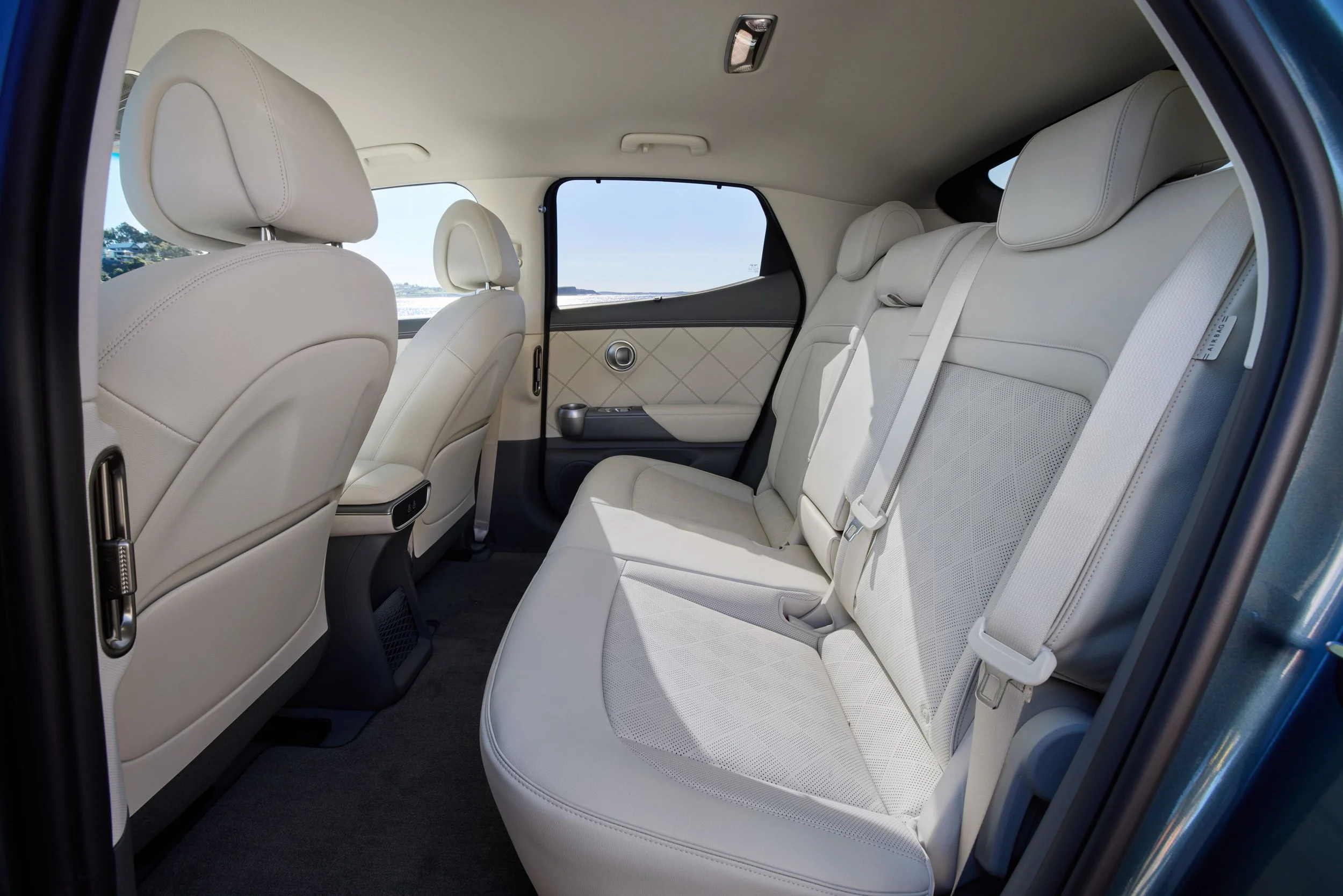
Adults fit in the back, although taller passengers may find knee and toe room tighter than expected given that generous wheelbase. Headroom is decent despite the GV60's coupé-like roofline.
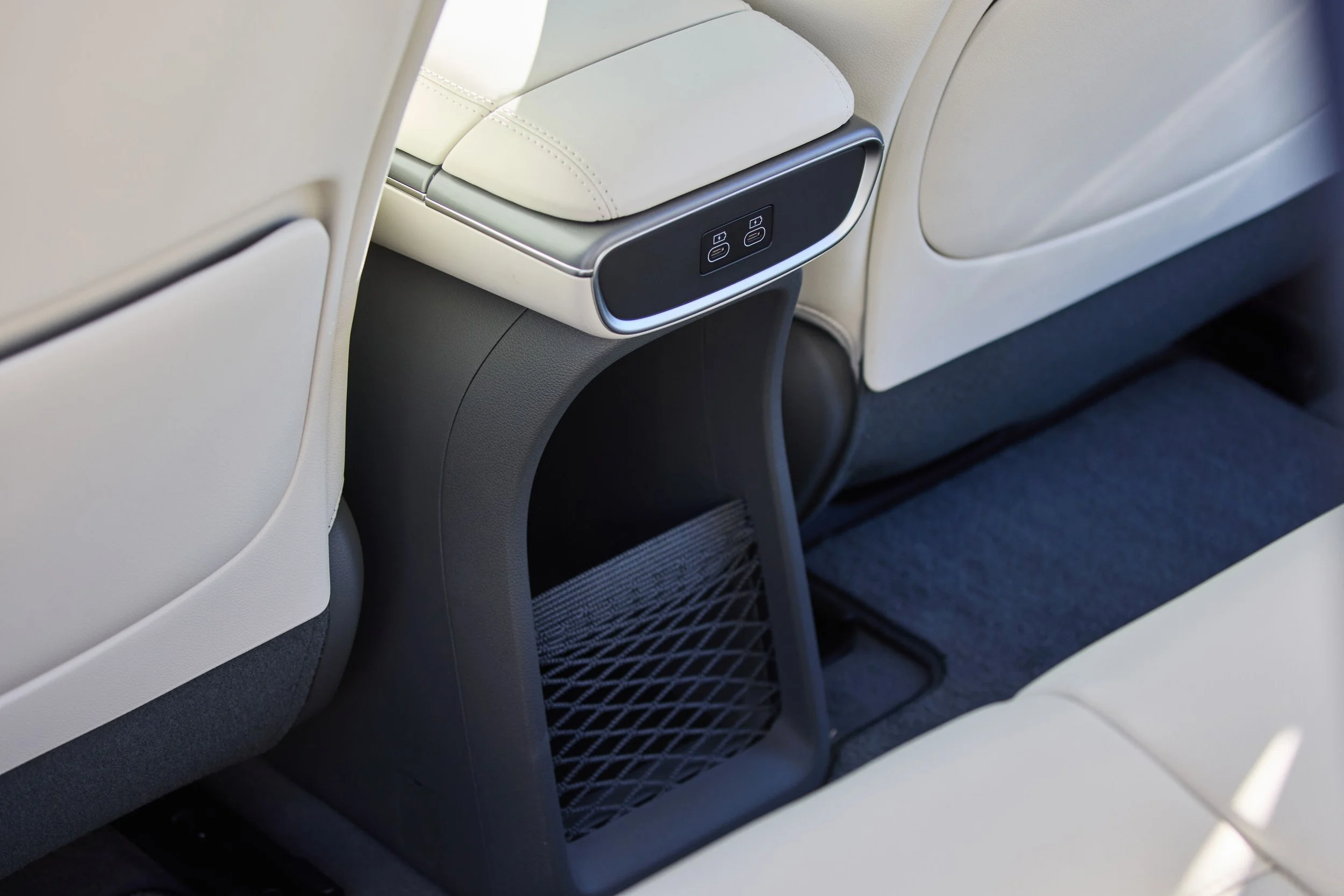
For families, however, there's plenty to like. Rear passengers get B-pillar-mounted air vents, USB charging, map pockets, door storage, a folding centre armrest with cupholders and manual rear sunshades.
There are ISOFIX mounting points on both outer rear seats and three top-tether points.
And speaking as someone who actually puts children into the back of these things rather than simply attacking the seats with a tape measure, those details matter.
Rear sunshades matter.
Charging points matter.
Storage matters.
And apparently the rotating crystal ball at the front matters enormously.
Boot Space and Practicality
Right.
Practicality.
Because we've promised ourselves we're never forgetting this bit again.
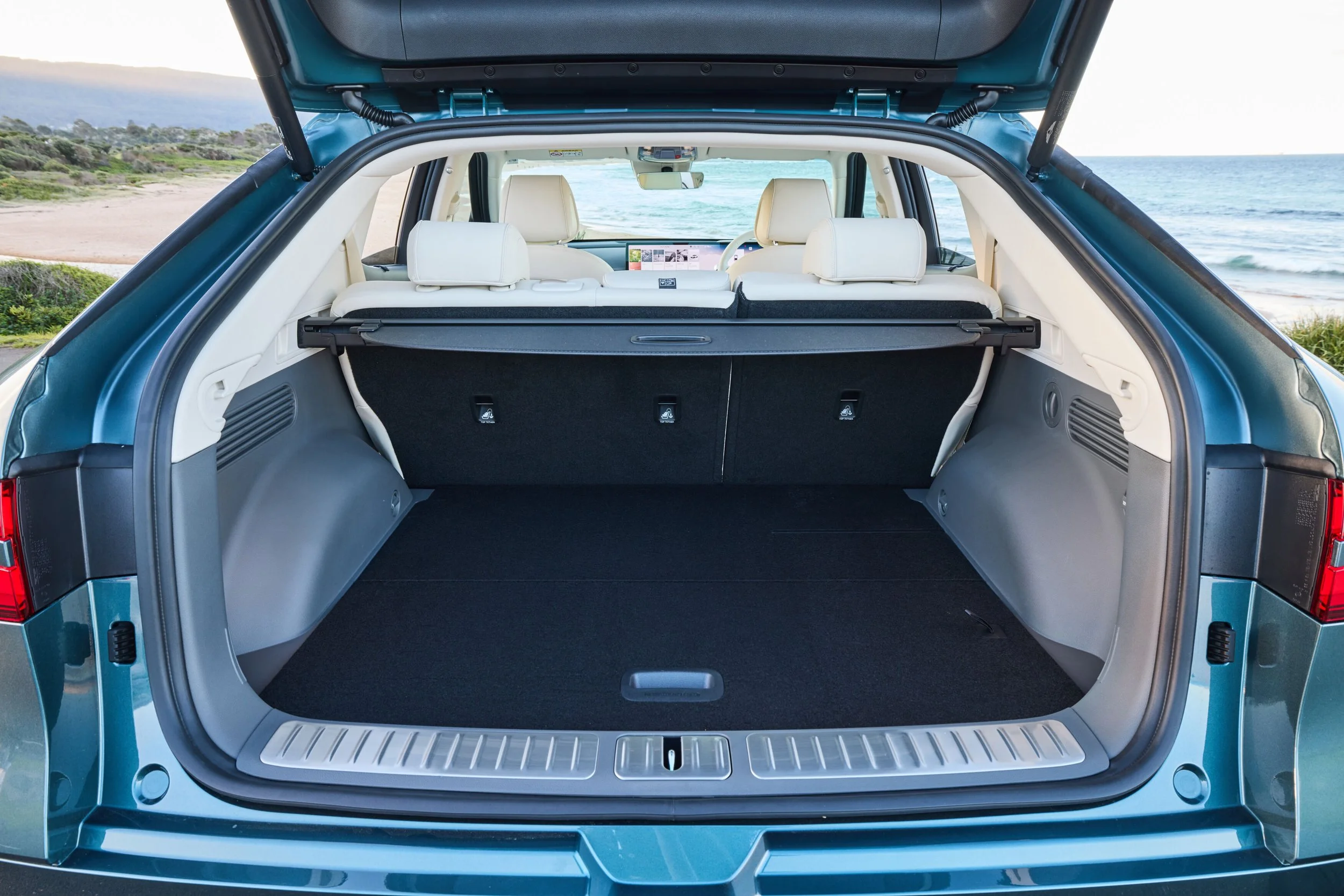
The GV60 offers 432 litres of luggage capacity behind the rear seats. That's perfectly usable rather than cavernous, and the sloping rear bodywork inevitably sends an invoice when it comes time to carry bulky things.
There's useful underfloor storage for charging cables, along with a 12V outlet, luggage light and cargo cover.
What you don't get is a spare wheel.
Instead?
Tyre repair kit.
Welcome to modern EV ownership.
Powertrain
Underneath, the Advanced uses a single permanent-magnet electric motor mounted at the rear, producing 168kW and 350Nm through a single-speed reduction gear.
Kerb weight is around 2045kg, while the claimed 0–100km/h time is 7.8 seconds.
There is something deeply amusing about describing 7.8 seconds as slow.
Twenty years ago that was perfectly respectable performance. Now we've driven enough electric cars capable of hitting 100km/h in four seconds that anything beginning with a seven looks like the vehicle stopped halfway through to answer an email.
But again...
Context.
The Advanced isn't the performance GV60.
Genesis now has an answer for people wanting the ridiculous one.
It's called Magma.
This car has a different job.
On the Road
Once you understand that, the whole thing makes considerably more sense.
The throttle calibration is smooth, progressive and easy. There's no need to delicately meter your right foot away from every intersection to prevent everyone's head hitting the headrest, and Comfort mode suits the GV60 beautifully.
Eco exists if you're particularly committed to squeezing every kilometre from the battery. Snow mode exists for Australians who...
Well.
Live somewhere considerably colder than Queensland.
And Sport?
Sport gives the accelerator a little more immediacy and wakes things up enough to remind you there's 350Nm available instantly.
But it doesn't transform the GV60.
Nor should it.
There's enough performance for overtaking, enough for motorway merging and enough to squirt through a gap in traffic. Then you settle back down again.
That's where this GV60 wants to live.
Ride and Refinement
Comfort matters enormously here, and Genesis has clearly understood the assignment.
Around town, the GV60 deals well with the usual collection of potholes, expansion joints, road repairs and assorted Australian-road bullshit. There's compliance, softness and isolation.
It's not floaty in the traditional old luxury-car sense, but it takes the edge off the road rather than constantly reporting every surface imperfection to your backside.
Push harder and you'll notice the compromise. This is still a two-tonne electric crossover, and larger compressions can introduce more body movement than you'll find in something aggressively tied down.
But again:
Do you care?
If Genesis had sacrificed ride quality to make the Advanced marginally better through a sequence of corners, I think it would have misunderstood its own car.
The Advanced is at its best when you're not trying particularly hard.
And I mean that as a compliment.
Refinement is similarly impressive. Removing an internal-combustion engine doesn't automatically make an EV quiet; sometimes it simply exposes tyre roar, wind noise and suspension noise that several thousand controlled explosions were previously masking.
Genesis has paid attention here. Acoustic laminated glass and additional noise suppression help create a cabin that feels properly isolated.
Conversations happen at normal volume. Music doesn't need to fight the road.
The whole thing encourages you to relax.
Steering and Handling
The steering is light enough around town but gains useful weight as speeds increase. It's accurate, predictable and easy to place.
Are we about to write several paragraphs about delicate messages arriving through the steering rim as the front tyres approach the limit of adhesion?
No.
It's not a Lotus Elise.
But the rear-wheel-drive configuration gives the Advanced a pleasantly natural balance. There's something satisfying about having the propulsion happen behind you, while the front wheels are largely left to get on with steering.
The result isn't exciting in the traditional sense.
It's simply...
Nice.
And I'm increasingly convinced that's exactly the point.
Regenerative Braking
The steering-wheel paddles control the level of regenerative braking.
Excellent.
This remains one of our favourite implementations because it lets you change the car's behaviour without diving into a menu.
Want it to coast? Dial the regeneration back.
Want stronger deceleration? Pull the paddle.
Want proper one-pedal driving?
Select i-Pedal.
Once you're accustomed to it, urban driving becomes wonderfully easy. Accelerate, lift, slow, stop.
Genesis has also done a good job blending regenerative braking with the conventional friction brakes. The pedal doesn't suddenly change character halfway through its travel.
It feels natural.
Which sounds like faint praise until you've driven an EV where it doesn't.
Battery, Range and Efficiency
Underneath sits an 84kWh NMC lithium-ion battery, replacing the previous GV60's 77.4kWh pack.
That brings one of the Advanced's most important improvements:
561km of WLTP range.
Now we're talking.
Because somewhere beyond 500km, range anxiety starts becoming considerably less interesting. At that point, the car can often travel further between stops than the humans inside it actually want to.
Coffee.
Food.
Bathroom.
Children asking "Are we there yet?" for the 47th time.
Eventually biology becomes the limiting factor rather than lithium-ion chemistry.
Official combined energy consumption is 16.8kWh/100km, which is respectable for a two-tonne premium electric crossover. Real-world consumption will obviously vary with temperature, traffic, speed, climate control and how enthusiastically you're using the accelerator.
But paired with that 84kWh battery, the Advanced has moved beyond the point where range feels like something you need to constantly manage.
And that matters more to me than shaving another second from the 0–100 time.
Charging
This is where the E-GMP architecture continues to shine.
The GV60 supports 11kW AC charging and up to approximately 260kW DC fast charging.
Find sufficiently powerful infrastructure under suitable conditions and Genesis quotes roughly 18 minutes for a 10–80 per cent DC charge.
Eighteen minutes.
That's excellent.
Obviously, that's the ideal scenario. You need the right charger, the battery needs to be at the appropriate temperature, the charger itself needs to actually deliver what it says on the sticker, and Mercury presumably needs to be in retrograde or whatever else Australia's public charging network occasionally requires.
But the underlying capability is there.
And the combination matters.
561km range. Very fast DC charging.
For a luxury EV, that's much more compelling to me than another hundred kilowatts.
Vehicle-to-Load
The Advanced also supports Vehicle-to-Load, or V2L, through an external adaptor connected to the charging port.
That effectively turns the high-voltage battery into an enormous mobile power source for compatible external devices. Camping equipment, laptops, appliances — whatever your particular electricity-dependent adventure requires.
The Advanced doesn't get the internal second-row V2L outlet offered on some higher GV60 specifications elsewhere.
Not disastrous.
But worth knowing.
Exterior
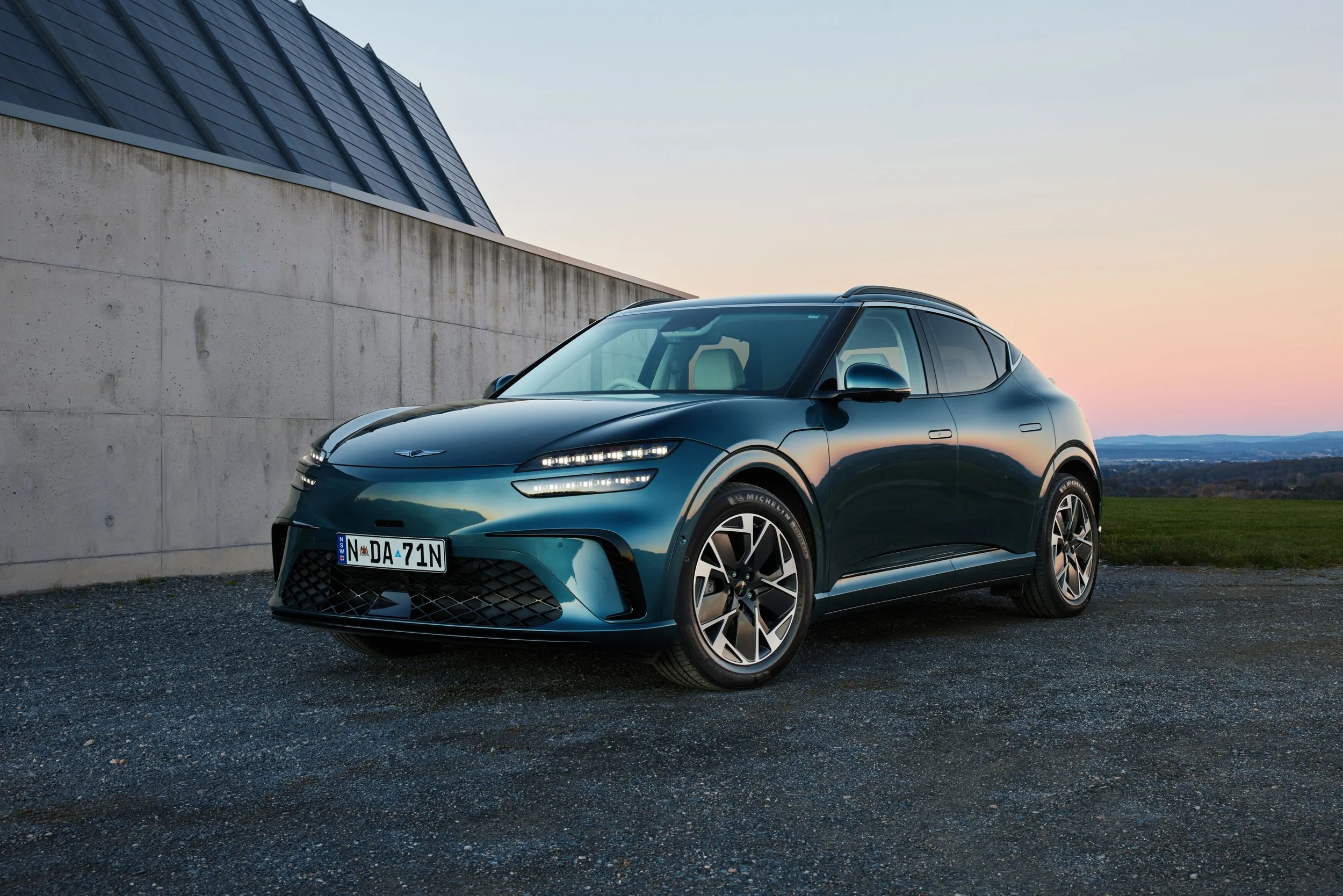
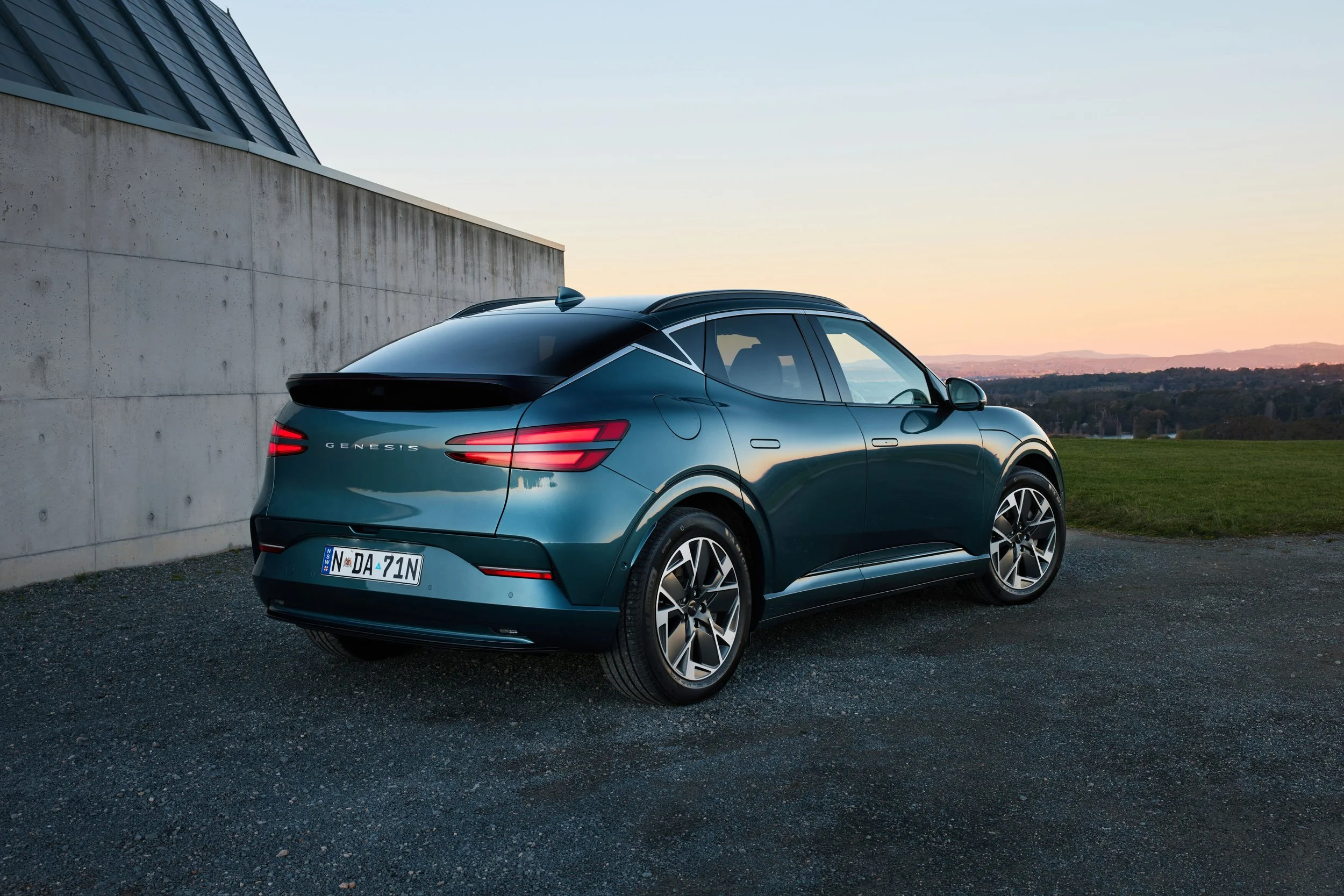
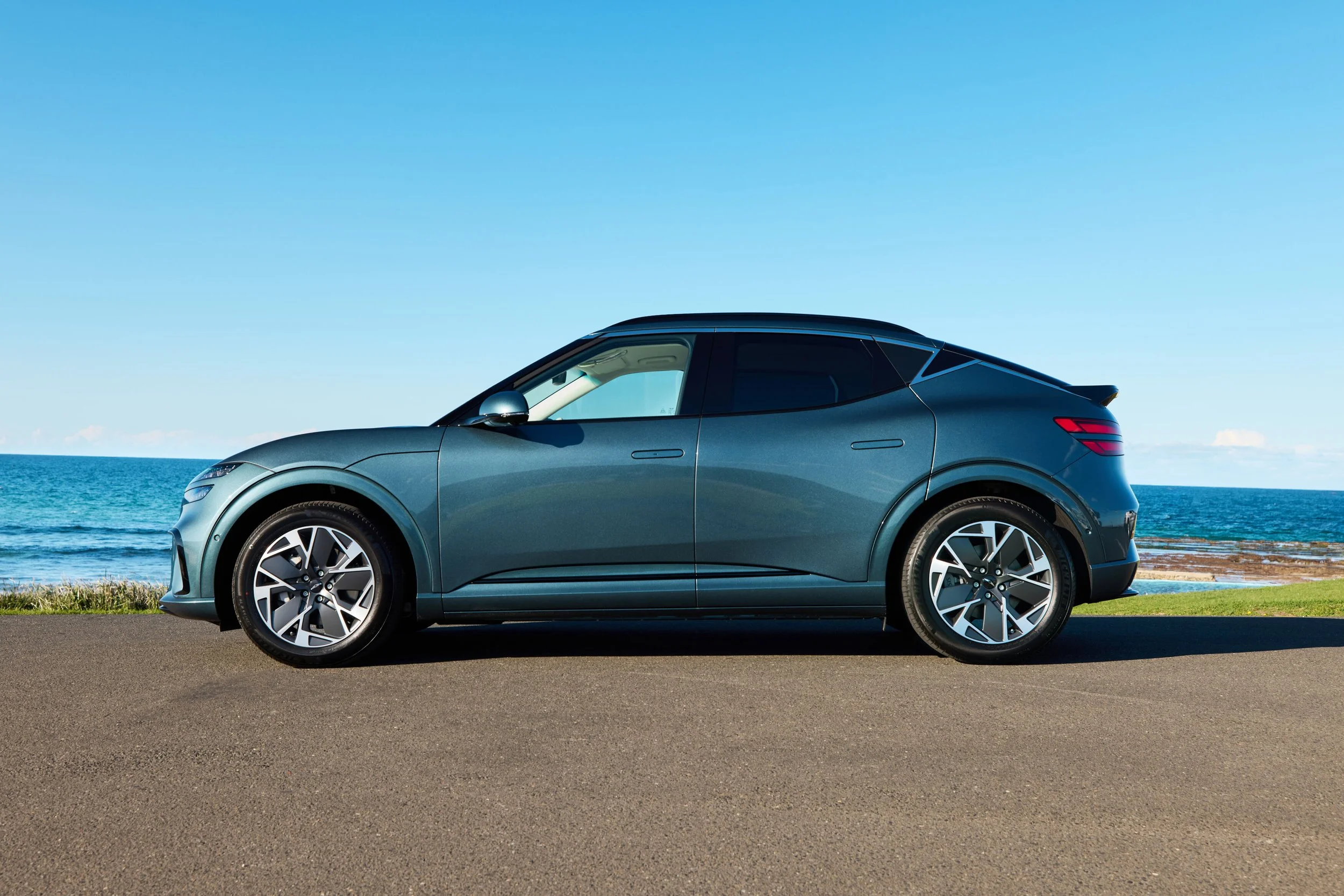
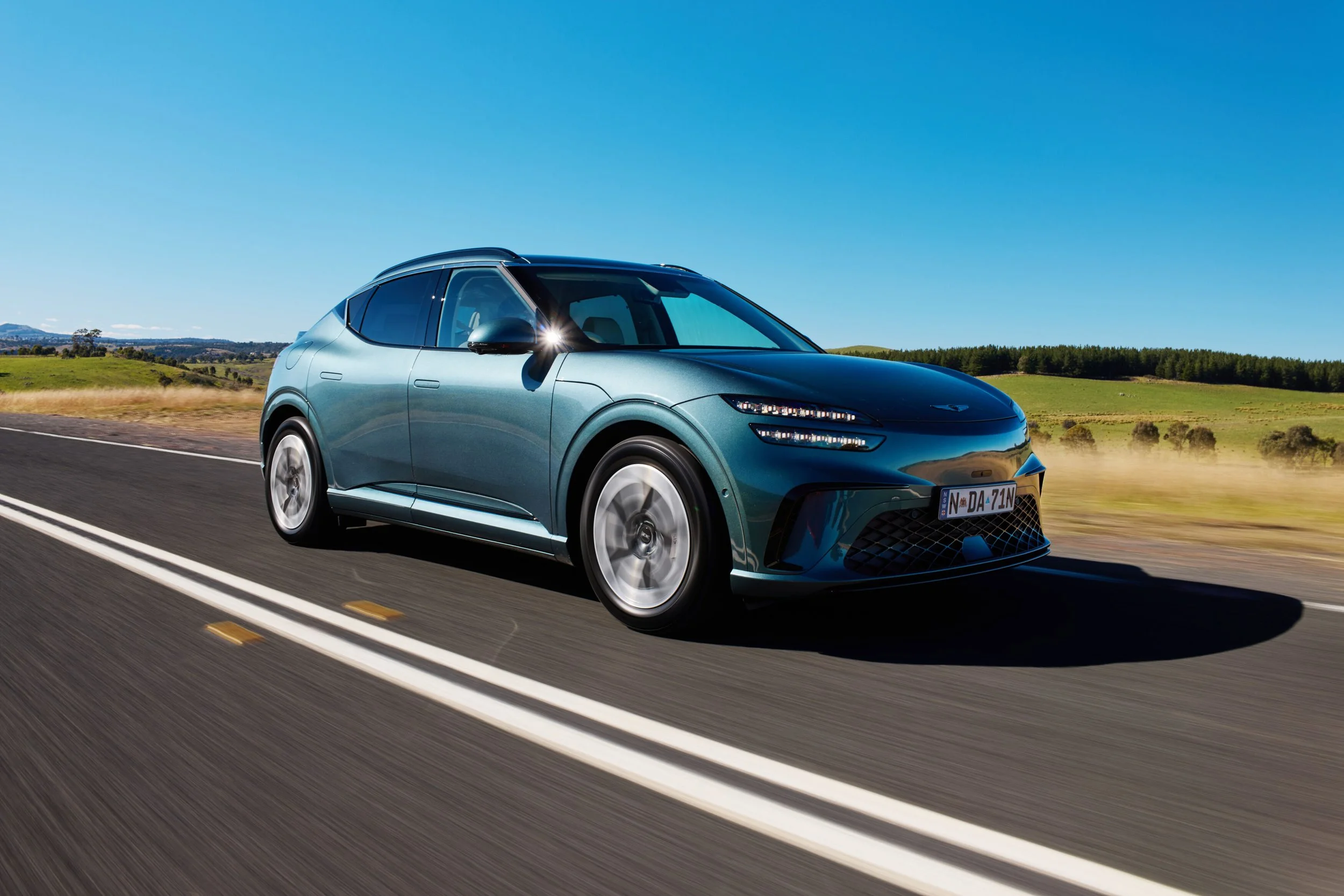
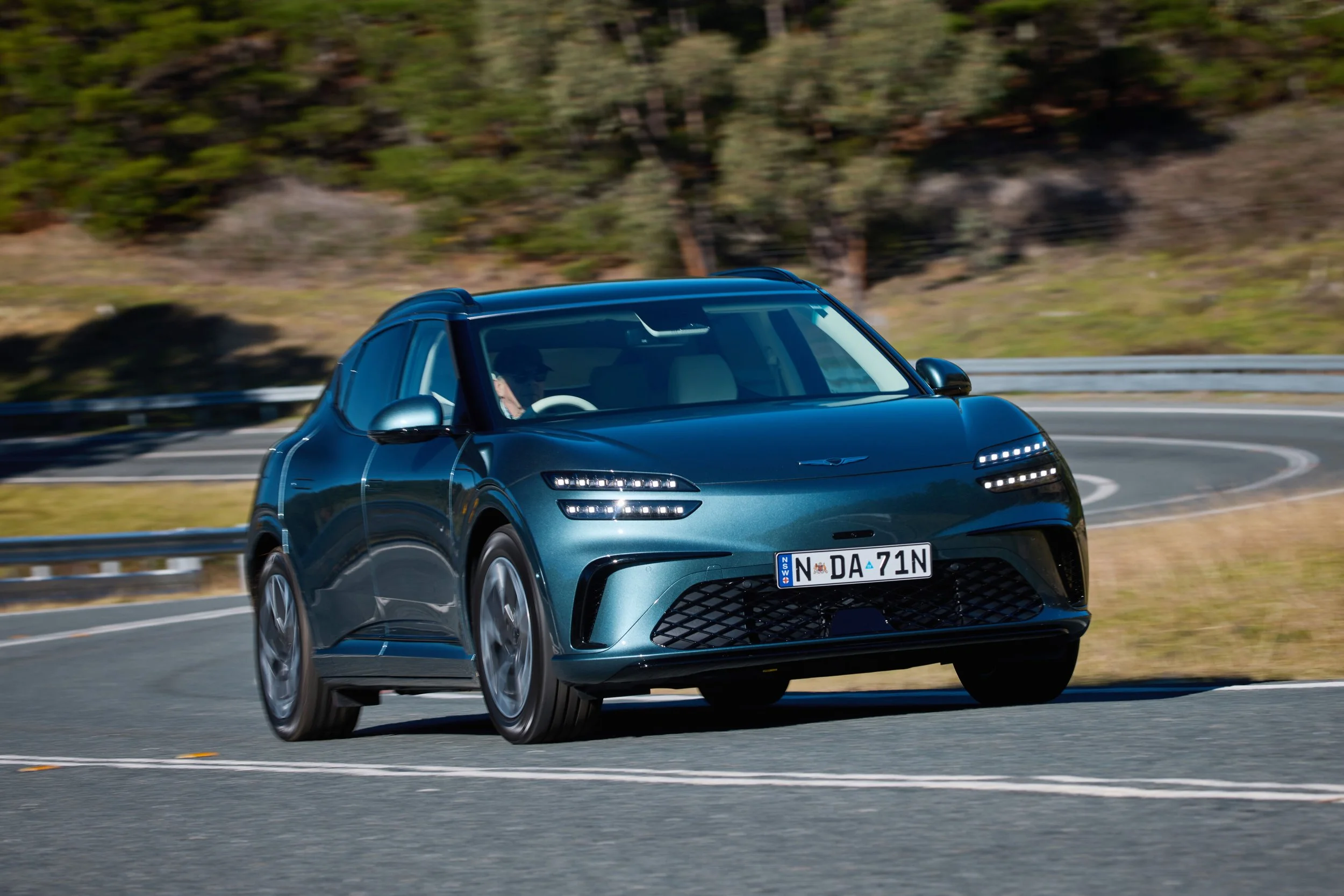
The GV60 remains an unusual-looking thing.
And I mean that positively.
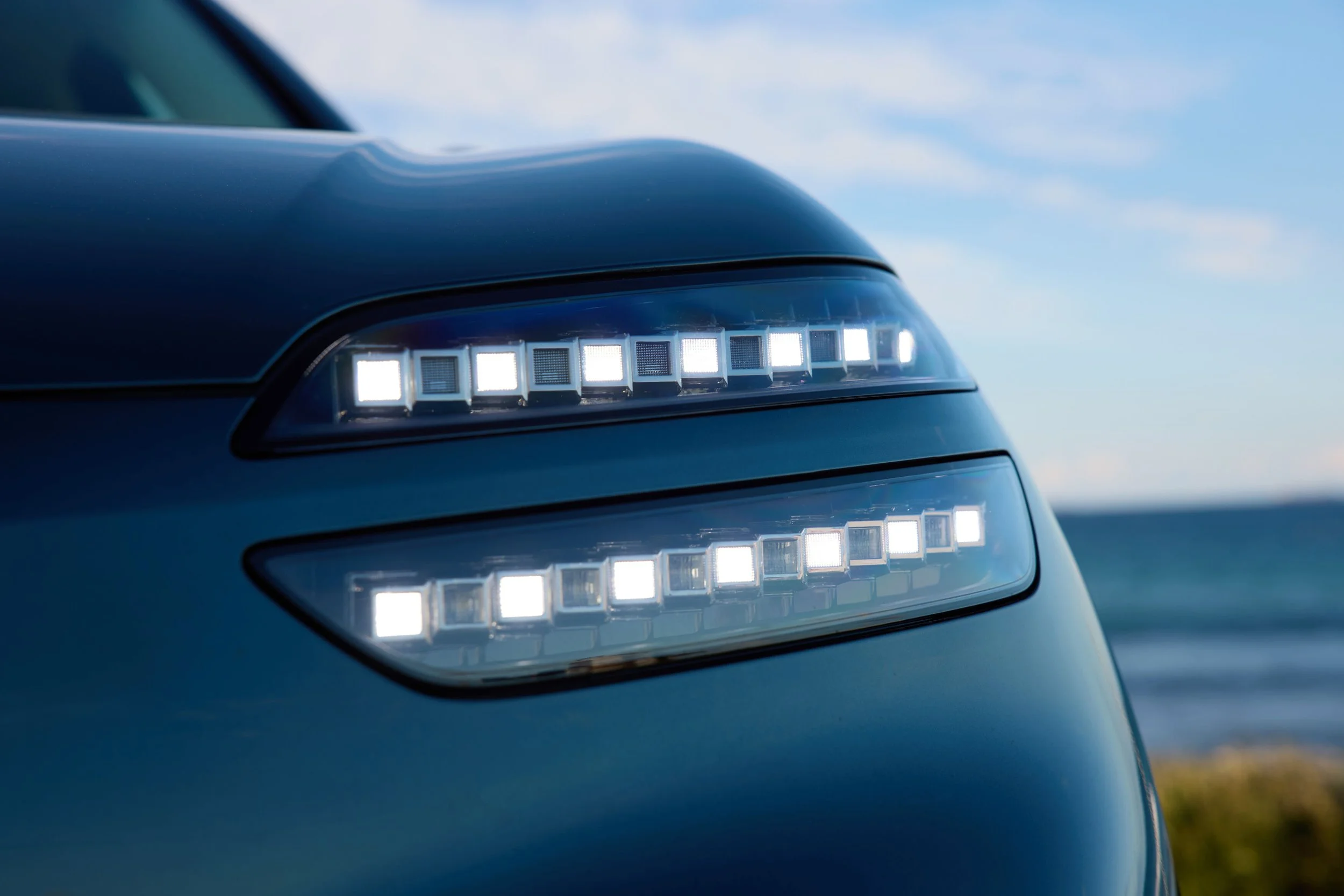
There's the familiar Genesis twin-line lighting signature, clamshell bonnet, low-mounted Crest Grille, flush door handles, curved roofline and distinctive rear spoiler.
The facelift hasn't radically reinvented the shape.
Good.
It didn't need to.
There's increasing homogenisation happening among electric cars.
Smooth nose.
Thin headlights.
Big wheels.
Flush handles.
Blob.
The GV60 has identity.
Whether everybody loves that identity is another question, but at least it has one.
The Advanced rides on 19-inch alloy wheels, and thank God for that too.
Apparently EVs are otherwise contractually obligated to wear wheels roughly the same diameter as the London Eye.
Nineteens are plenty. They look good, leave some actual tyre sidewall and contribute to the GV60's comfort-first character.
A luxury car riding better because someone resisted fitting enormous wheels purely for the brochure photography?
Thank you, Genesis.
Cameras and Parking
The Advanced gets a surround-view camera system with 3D functionality, along with Genesis' excellent Blind-Spot View Monitor.
Indicate and a camera view of the corresponding blind spot appears in the instrument display.
It's one of those features that initially feels like technology for technology's sake.
Then you live with it.
Then you drive something without it.
Then you miss it.
There's also Remote Smart Parking Assist, which can help manoeuvre the GV60 in tight situations.
Necessary every day?
No.
Useful when someone parks approximately fourteen millimetres from your driver's door?
Very.
Safety
The GV60 carries a five-star ANCAP safety rating, originally awarded in 2022. It scored 89 per cent for adult occupant protection, 89 per cent for child occupant protection, 63 per cent for vulnerable road-user protection and 88 per cent for safety assist.
There are 10 airbags, including a front-centre airbag and driver's knee airbag, along with front and rear side protection.
The active-safety package includes autonomous emergency braking with pedestrian and cyclist detection, adaptive cruise control, blind-spot monitoring, lane-keeping assistance, driver-attention monitoring, intelligent speed assistance, Safe Exit Assist, parking sensors, rear collision avoidance, surround-view cameras and the aforementioned blind-spot camera system.
The forward collision system can also intervene in certain junction and lane-change scenarios.
In other words:
There's a lot watching you.
Bings and Bongs
Which inevitably means...
Bing.
Modern cars love telling you things.
Speed limit changed. You're slightly over it. Lane marking. Something ahead. Something beside you. Something somewhere in the southern hemisphere has occurred.
BING.
The GV60 isn't the worst offender we've encountered.
Not even close.
Thankfully, various alerts can be adjusted, with some preferences remaining set between drives.
That last bit matters.
Because having to disable the same overenthusiastic safety warning every single time you start a car is how perfectly normal people eventually begin shouting at dashboards.
Ownership
Genesis backs the GV60 with a five-year, unlimited-kilometre vehicle warranty, while the high-voltage battery is covered for eight years or 160,000km.
Scheduled servicing is required every 12 months or 15,000km, and Genesis includes the first five years or 75,000km of scheduled servicing at no additional cost.
There's also roadside assistance and Genesis' concierge-style ownership programme, including vehicle collection and return for eligible scheduled servicing.
This stuff matters.
Genesis is asking buyers to choose it over brands that have spent decades establishing their luxury credentials, so the ownership experience needs to feel premium too.
It isn't enough to put leather on the dashboard and call it a day.
The Value Question
And now we arrive at the uncomfortable bit.
$88,300 before on-road costs.
There are cheaper EVs.
Much cheaper EVs.
Some offer more power. Some offer more interior space. Some offer more equipment. Some will accelerate considerably harder.
And increasingly, Chinese manufacturers are making the old argument that cheap equals nasty extremely difficult to sustain.
Then you've got the established luxury competition from BMW, Mercedes-Benz, Audi, Lexus and others, carrying enormous brand recognition and decades of accumulated prestige.
So where does Genesis fit?
Somewhere interesting.
Because I don't think you buy the GV60 Advanced because it wins a spreadsheet.
You buy it because you sit inside one and think:
Oh. This is nice.
And then you keep noticing things.
The materials. The silence. The seats. The drawer. The cameras. The Crystal Sphere. The way it rides. The way everything feels slightly different from the obvious alternatives.
It's a harder quality to quantify.
But luxury always has been.
What It's Missing
It's not perfect.
Rear-seat space could be better. The 432-litre boot isn't enormous. There's no spare tyre, and the infotainment system can require more digging through menus than we'd like.
Some of the previous GV60's luxuries have also disappeared from the Advanced as Genesis brought the entry price down.
And yes, for almost $90,000 before on-roads, some people are going to look at what considerably cheaper EVs provide and struggle to make the numbers work.
That's completely reasonable.
The GV60 Advanced isn't the rational value champion of the electric-car market.
It doesn't pretend to be.
But there's something else it does very well.
It Knows What It Is
This is what stayed with me.
The GV60 Advanced doesn't feel insecure about its performance.
It doesn't constantly remind you how much power it has. It doesn't need a ridiculous launch sequence. It doesn't need to pin your head against the restraint every time you touch the accelerator.
It doesn't feel like Genesis engineers sat around a table worrying that somebody else's crossover reached 100km/h three-tenths faster.
They appear to have asked a different question.
What does this version actually need?
168kW.
350Nm.
Rear-wheel drive.
561km of range.
Very rapid charging.
A quiet cabin.
Comfortable suspension.
Lovely seats.
Good materials.
Useful technology.
And a crystal ball that flips over every time you turn the bloody thing on.
That's enough.
Verdict
Maybe that's why I liked the GV60 Advanced more than its numbers suggested I would.
Because if you'd handed me the specification sheet first, I'd have immediately circled one figure.
7.8 seconds.
Really?
Nearly ninety grand for an EV and it takes 7.8 seconds to reach 100km/h?
Then I drove it.
And after a while...
I stopped thinking about that number entirely.
I didn't care.
The GV60 doesn't create an environment where you're constantly searching for performance. Quite the opposite. It encourages you to relax.
The steering is easy. The ride is comfortable. The motor is smooth. The cabin is quiet. The seats are lovely. The range is excellent.
And when you do need some extra response?
Sport mode.
Little squeeze of the accelerator.
There you go.
Enough.
There's something strangely mature about that.
Especially now.
We're living through an electric horsepower war where family crossovers are producing outputs that would have embarrassed supercars not particularly long ago.
And don't misunderstand me.
I like stupidly fast things.
A lot.
We're about to drive the GV60 Magma, for God's sake.
I am very much looking forward to finding out what happens when Genesis takes this beautifully calm little environment and gives it an anger-management problem.
But that's another car.
The Advanced doesn't need to be Magma-lite.
It shouldn't be.
Its job is different.
There are faster electric SUVs. There are cheaper electric SUVs. There are larger electric SUVs. There are EVs that will look considerably more impressive in a specification comparison.
But few numbers on a specification sheet can explain the thing I enjoyed most about the GV60.
The atmosphere.
That feeling when you climb inside, press the start button and watch the Crystal Sphere rotate — accompanied, in my case, by two fascinated little girls.
Select Drive.
Pull away.
And realise you don't particularly care about racing the bloke beside you.
You don't need to.
You've got 561 kilometres of claimed range, a comfortable seat, a quiet cabin, some music and enough performance to do everything you actually need to do.
Maybe luxury isn't always about having more.
Maybe sometimes luxury is reaching the point where you stop asking for it.
168kW. 350Nm. 7.8 seconds.
Enough.
And you know what?
That's absolutely fine.